
Apr 26, 2021
1,000 fans to attend Jersey Reds v Nottingham
23 April 2021 – Over 1,000 English rugby fans will once again experience the thrill of live rugby when Jersey Reds play host to Nottingham Rugby in the Greene King IPA Championship on Saturday 24 April 2021.
Jersey Reds will be the first team in English rugby to play in front of supporters in 2021 in what is the first game in front of fans at Stade Santander International Stadium since February 2020. It follows a decision by the Government of Jersey to allow fans back into stadiums in a strictly controlled fashion.
The return of fans to the stadium has been assisted by Future Ticketing, whose powerful software solution has provided multiple safety and compliance tools to ensure strict social distancing and attendance rules are in force.
The Jersey Reds’ fan experience is operated through an API integration of the Jersey Reds website – managed by The Refinery – that enables members and season ticket holders to log into the website to claim their tickets, with all attendee information featured on a GDPR compliant dashboard.
On Saturday, customers’ tickets will be scanned at each entry point in real-time along with the customers’ temperature, which will prompt additional attention should the customers’ temperature be higher than 37 degrees Celsius.
Commenting, Sean Dunne, Operations Manager, Jersey Reds, said: “We have had to prepare carefully for this home game, and once we knew it would be possible for spectators to attend, Future Ticketing was able to work with our website partners in setting up a reliable system. This enabled supporters to book their tickets, while giving the club secure access to customers’ contact details for track-and-trace purposes. We are excited and we can’t wait to have our fans back at the Stade.”
Commenting, Liam Holton, CEO of Future Ticketing, said: “The safe return of fans to sport in the UK is another milestone on the journey towards normalising society. We are delighted to help enable the return of fans safely to watch in person their beloved Jersey Reds. Over the last year, our team worked really hard to add technology tools such as social distancing seating, temperature control scanning, strict capacity management and contact tracing to ensure fans could return to games in a safe and compliant manner. The team at Jersey Reds has diligently worked towards this day for a long time and this unerring commitment to their fans has been second to none. We look forward to this being the first of many games where fans can get back to the heart of the action.”
Upcoming games at the Santander International Stadium include Jersey Reds facing Coventry Rugby on May 15th and Cornish Pirates on May 29th, where fans can continue to attend the stadium and experience live action in-person.
Future Ticketing
Future Ticketing is a leading provider of high-performance ticketing and sales-enabling digital software. We provide a cost competitive modern digital solution that enables events and venues to sell tickets directly through their own website and to monetise data.
For further information please visit our website at www.futureticketing.co.uk
Further information:
Ann Marie Guinan
UK Country Manager
annmarie@futureticketing.ie

Apr 23, 2021
23/04/2021
Alliance welcomes D-Day on insurance premiums
Says insurers must deliver significant reductions immediately
The Alliance for Insurance Reform has welcomed the implementation of the new judicial guidelines on personal injury payments, which come into effect this weekend.
Peter Boland, Director of the Alliance, said “Monday next, 26th April, the first working day following the implementation of these new guidelines, is D-Day. From this day, we expect the cost of motor and liability insurance policy renewals to drop significantly. The new guidelines, signed off by the Judicial Council in March, do not deliver the 80% reduction in minor injury damages that is necessary to bring us close to comparable jurisdictions. But at an estimated 50% reduction, it is nonetheless significant. Insurance premiums are based on future risk and every accident that happens from Monday and the majority of claims already made will be subject to the new guidelines, so the risk associated with every new motor and liability policy in Ireland will drop significantly and that must be reflected in the cost of those policies.”
Eoin McCambridge, Managing Director of McCambridge’s of Galway and director of the Alliance said “Insurers have consistently argued that the cost of claims drives the cost of insurance. This has been backed up by analysis the Alliance carried out with the Central Bank which shows that 42% of every single motor insurance policy is currently swallowed up by compensation payments*. From Monday, future payments will drop by an estimated 50% and there will be follow-on reductions in legal costs, broker commissions, Motor Insurer’s Bureau costs and reinsurance costs. So insurers must deliver significant reductions immediately to reflect this new reality.”
Tracy Sheridan, owner of Kidspace play centres in Rathfarnham and Rathcoole and director of the Alliance said “It is difficult to overstate the importance of this Monday for Irish motorists, charities, voluntary & community groups, sports & cultural organisations and SMEs which have long suffered from unsustainably high insurance costs. It is now up to insurers to deliver on their commitments and for Government to ensure they do so. Government must then follow through with reform of the duty of care and of the Personal Injuries Assessment Board so that insurance costs can be reduced to affordable levels and kept that way.”
ENDS
NOTES:
Department of Justice announcement of implementation here:
https://www.gov.ie/en/press-release/b7b52-minister-mcentee-announces-commencement-of-the-personal-injuries-guidelines/
*”42% of every single motor insurance policy is currently swallowed up by compensation payments” – see pie chart in bottom left hand corner of our Infographic here:
https://insurancereform.ie/wp-content/uploads/2020/10/air-infographic-no2-final.pdf
Apr 23, 2021
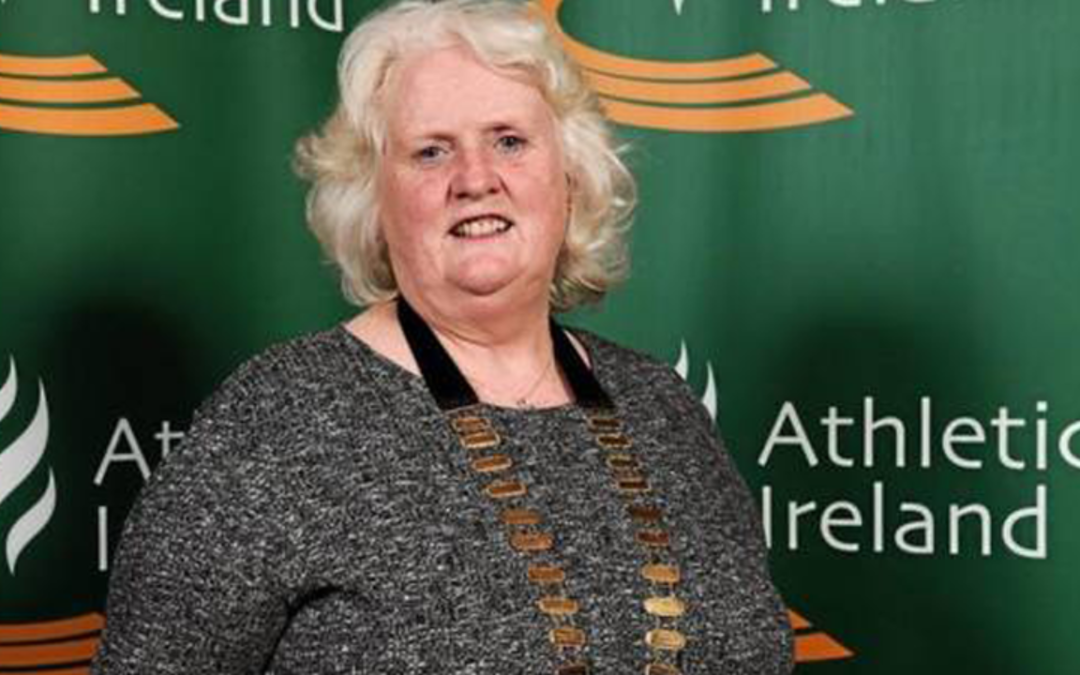
On Thursday evening, the Federation of Irish Sport honoured the dedication and service of President of Athletics Ireland, Georgina Drumm as one of their Outstanding Contribution recipients for 2021. The presentation was part of a joint recognition award for two stellar members of the sporting community, with the second recipient to be announced in later this year. The honour, which usually forms part of the Irish Sport Industry Awards, provided the finale for what has been an incredibly insightful and engaging three evenings of discussion and debate.
Speaking about the worthy recipient, Federation of Irish Sport Chairperson Clare McGrath said, “Our sector is built on the dedication and hard work of so many individuals who turn their passion for their sport or activity into a life of service. Our Outstanding Contribution recipient, Georgina, epitomises that and we are delighted to be able to recognise her efforts. While we chose not to host our Irish Sport Industry Awards this year, we felt it was appropriate and indeed necessary to continue the tradition of the Outstanding Contribution award. We will also release details of a second recipient later this year. I am delighted as Chairperson to be able to spotlight and honour the work of Georgina today”.
A history breaking legacy for Georgina Drumm, the first female president of Athletics Ireland which under her stewardship saw female membership increase by 20,000 between 2008 and today.
Georgina Drumm made history as the first female president of Athletics Ireland in 2016 after a long history of roles within the sport. Like many, Drumm’s involvement with athletics began many years ago when she brought her son, then aged five, to a local sports day. She joined her local club Mountpleasant AC and soon became involved in administrative roles and quickly moved up the ranks to serve as Registrar, Competition Secretary and Chairperson with the Louth County Board. She was also the Chairperson of the Leinster Provincial Council for a number of years. At national level Drumm was Secretary of the NACAI from 1997 to 1999 and, following that association’s merger with BLÉ to form Athletics Ireland – a move which she strongly supported – she served as joint Secretary of the unified governing body during the transition period from 1999 to 2002. Following the completion of that transition period, Drumm was elected as sole Secretary of Athletics Ireland in 2002 and continued in that role until 2006 when a full time CEO was recruited. In 2015 she received the prestigious European Athletics Women’s Leadership Award and in 2017 she was elected to the board of the Olympic Federation of Ireland.
A superb three evenings of reflection and inspiration
Speaking about the series as a whole, Mary O’Connor, CEO of the Federation of Irish Sport said, “The series has been a hugely enjoyable and worthwhile event. Similar to many when faced with the challenge of hosting an event during the pandemic, we chose to innovate and adapt our traditional ceremony to produce a series that would bring people together in a positive, engaging and thought provoking virtual setting. The three evenings provided a much needed opportunity to reflect but also to look towards the future and the role of sport and physical activity as we emerge from a difficult 12 months. We were treated to some fantastic discussion from our guests, and I have no doubt, we are all leaving with a sense of positivity about an innovative future for sport and physical activity’.
The series covered three core areas: investment, international and innovation through a combination of keynote interviews and panel discussions including ‘Sport and Physical Activity as a vehicle for corporate investment’, ‘Bringing international sporting events to Irish shores’ and ‘The role of digital transformation and innovation for the sport and physical activity sector’. Contributors brought a variety of insight and experience from government departments, international projects, market leading multinational corporations, philanthropic investment organisations and sporting bodies.
ENDS

Apr 22, 2021
Sport Ireland
Media Release
22nd April 2021
Sport Ireland announce €40 million investment in sports sector
- €13.8 million for core activity of 59 National Governing Bodies
- €9.5 million to support work of 29 Local Sports Partnerships
- €8.5 million to support High Performance programmes
- €2.68 million in International Carding scheme
Sport Ireland today announced an investment of €40 million to National Governing Bodies for Sport (NGBs), High Performance athlete support and to the network of Local Sports Partnerships (LSPs) for 2021.
Today’s announcement follows a year in which the sector has been significantly impacted by Covid-19 restrictions in place since March 2020.
The funding of €13.8million for NGBs is maintained from 2020. This funding, in addition to the recently allocated Covid-19 Grant Scheme, will provide stability and certainty to organisations throughout 2021. In line with previous years, a portion of the Core funding budget (‘Special Projects & Programmes’) will be ring fenced to assist with strategically important NGB related events and projects.
Welcoming today’s announcement, Minister for Tourism, Culture, Arts, Gaeltacht, Sport and Media Catherine Martin acknowledged the importance of sport and physical activity; “The past year has shown us yet again the important role that sport and physical activity plays in our lives and the vital contribution it makes to our physical and mental wellbeing. I am delighted to announce today’s funding to the sport sector to further assist the work of National Governing Bodies and Local Sports Partnerships to encourage people to be more active and to support their ongoing development. In Budget 2021, the Government made a commitment to support the sector and we are engaging closely with the sector to ensure their needs are met and that sport will emerge from the Covid-19 crisis in a strong position.”
High Performance Programme funding will also be maintained for 2021 at €8,500,000. 2021 is anticipated to be an expensive year for high performance programmes as there remains a high level of uncertainty around competition and training camp plans due to Covid-19. Sport Ireland will provide further support in 2021 to address the immediate and confirmed costs to high performance programmes in respect of the Olympic and Paralympic Games.
Minister of State for Sport & the Gaeltacht Jack Chambers TD acknowledged the difficulties faced by the High Performance community in recent months: “Ireland has big ambitions on the international stage and the funding announced today will assist in furthering these ambitions. While the Olympic and Paralympic Games were postponed in 2020, the hard work and commitment from our high performance athletes, their National Governing Bodies and their support teams has continued over the past year and we are all now greatly looking forward to the summer games and beyond. This funding will provide certainty to our organisations after this difficult period and cover costs like coach development, hosting of events and delivering strategic plans. I am also very pleased we are once again providing ring-fenced funding for the Women in Sport programmes through the Local Sports Partnerships.”
The investment in high performance sport is bolstered by funding of €2.68 million through the International Carding Scheme. The International Carding Scheme provides financial support to 130 athletes and 6 Tokyo targeted relays / squads across 16 sports. The primary purpose of this funding is to support Irish athletes in reaching finals and achieving medals at European, World, Olympic and Paralympic level. The level of funding on this scheme has increased from €2.4 million in 2020. The International Carding Scheme has been amended to account for the challenges faced by athletes and NGBs as a result of Covid-19.
Budget 2021 saw a significant increase in funding for sport and physical activity, reflecting the commitment of Government and the Department of Tourism, Culture, Arts, Gaeltacht, Sport and Media to support the sector in to 2021. The hard work and agility of the sports sector to adapt to the Covid-19 pandemic has been acknowledged by Sport Ireland and the Government, and today’s funding announcement further strengthens the commitment to the sector.
Funding of €9.5 million has been approved for the network of 29 Local Sports Partnerships, representing an increase of 15% on 2020 funding. This increase in investment provides an opportunity for Sport Ireland to support a locally led safe return to sport and to further build the capacity of LSPs, increasing their reach and impact across Ireland.
Additionally Sport Ireland has announced its annual investment in the three large field sports – IRFU, GAA & FAI. A total of €2,389,653 has been allocated to the GAA and €2,250,843 to the IRFU. Funding provided by Sport Ireland supports vital coaching, games development and technical development programmes in both the GAA and IRFU. As per the Memorandum of Understanding agreed between the Government and the Football Association of Ireland, €5.8 million in funding will be made available to the FAI for football development programmes, pending approval by the Board of Sport Ireland.
Kieran Mulvey, Chairman Sport Ireland outlined the importance of providing stability to the sector in these uncertain times: “2020 was an extremely challenging year for the sports sector. It was faced head on by the sector and I commend the work of the funded bodies who showed resilience and agility in adapting to the many obstacles they faced throughout the year. The High Performance athletes, coaches and support staff have also showed incredible dedication and commitment to their sports in very difficult circumstances. The funding announced today will support the National Governing Bodies High Performance Programmes, the Sport Ireland Institute and other high performance facilities and direct athlete support and we look forward to cheering on these athletes again soon. On behalf of Sport Ireland, I think Minister Martin, Minister Chambers and their Department colleagues for the ongoing support.”
Chief Executive of Sport Ireland John Treacy highlighted the important role of community sport: “Throughout 2020, the network of 29 LSPs continued to help people get active in their communities by removing barriers to physical activity. They adapted quickly to the new “virtual” landscape and rolled out a broad range of local and national initiatives targeted at all the different cohorts of people. This funding will help LSPs continue this work and ensure that everyone in our society has the opportunity to share in the enjoyment as well as the mental and physical health benefits of sport and physical activity. But now we look forward, toward an Olympic and Paralympic Games, to the reopening of sport and physical activity for the general public and a light at the end of the tunnel. There is cause for optimism as children’s sport and some outdoor activity returns and we look forward to even more opportunities to enjoy sport and physical activity in the months ahead”.
Download the Investment Brochure here.
Ends.
For Further Information:
David Gash
Communications & Public Affairs Manager
dgash@sportireland.ie
087-2277643

Apr 19, 2021

Night One – Investment
Topic: An evening of discussion on investment in sport and physical activity hosted by Rob Hartnett
Description: The investment themed evening opens the Irish Sport Industry Innovation Series with a focus on the various strands of financial investment in the sector including government, corporate and project specific funding. The evening will consist of two panel discussions and a keynote address and conversation with Government Chief Whip and Minister of State with responsibility for Sport and the Gaeltacht, Jack Chambers.
The line-up:
7pm – Mary O’Connor, CEO Federation of Irish Sport
7.10pm – ‘Sport and physical activity as a vehicle for corporate and philanthropic investment’ – panel discussion with:
- Denise Charlton, CEO Community Foundation of Ireland
- Richie Gernon, Regional Director at EBS
- Aoife Clarke, Head of Communications at LIDL Ireland
7.40pm – Keynote address and conversation with Minister of State with responsibility for sport and the Gaeltacht, Jack Chambers.
8.10pm – ‘Trends and opportunities in innovation investment in Ireland and Europe’ – panel discussion with:
- Benny Cullen, Director of Research and Innovation at Sport Ireland
- Cormac MacDonnell, Innovation and EU Funding manager at Sport Ireland
- Alberto Bichi, Executive Director of EPSI
8.40pm – Close
Night Two – International
Topic: An evening of discussion on tourism, sports events and major international tournament bidding hosted by Declan Conroy.
Description: The international themed evening is the second in the Irish Sport Industry Innovation Series and will focus on the benefits and challenges of international sporting event hosting. The evening will also highlight the tourism infrastructure that makes Ireland a strong bidding nation when it comes to international events. The evening will consist of a keynote conversation with Orla Carroll, Director of Product Development at Failte Ireland as well as an in-depth panel discussion on the mechanics of bidding, hosting and evaluating international events on Irish shores.
The line-up:
7pm – Mary O’Connor, CEO Federation of Irish Sport
7.10pm – keynote conversation with Orla Carroll, Director of Product Development at Failte Ireland
7.40pm – ‘Bringing international sporting events to Irish shores – the benefits and challenges’ – panel discussion with:
- Hamish Adams, CEO Athletics Ireland
- Garrett Tubridy, Consultant and project manager of Women’s Rugby World Cup 2017
- Donal Hannigan, Principle Officer at the Department of Tourism, Culture, Arts, the Gaeltacht, Sport and Media.
8.30pm – Close
Night Three – Innovation
Topic: An evening of discussion on digital transformation and innovation in the sport and physical activity sector hosted by Trevor Keane.
Description: The investment themed evening closes the inaugural Irish Sport Industry Innovation Series with a focus on digital transformation and innovation trends and opportunities in the sport and physical activity sector. The evening will consist of a keynote conversation with Gráinne Barry, VP Digital and Business Operations at Stats Perform and co-founder of Sports Tech Ireland as well as a panel discussion on the trends and opportunities for innovation in the sector.
The line-up:
7pm – Mary O’Connor, CEO Federation of Irish Sport
7.10pm – keynote conversation with Gráinne Barry, VP Digital and Business Operations at Stats Perform and co-founder of Sports Tech Ireland
7.40pm – ‘Embracing digital transformation and innovation in the sport and physical activity sector’ – panel discussion with:
- Fiona Chambers, University College Cork
- Jill Downey, Managing Director at CORE Sponsorship
- Lewis Wiltshire, Seven League
8.10pm – Outstanding Achievement Presentations by Federation of Irish Sprot
8.40pm – Close
Apr 14, 2021
Today, the Federation of Irish Sport announced the final speaker for the upcoming Irish Sport Industry Innovation Series. Orla Carroll, Director of Product Development at Failte Ireland will join the International themed evening to discuss all things tourism, events and Ireland Inc. Orla’s announcement caps a stellar line up of contributors for the three days series focusing on Investment, International and Innovation for the Sport and Physical activity sector.

The Federation is delighted to welcome Orla Carroll of Failte Ireland, who will join host Declan Conroy for a discussion on event tourism, the impact of COVID-19 and the assets Ireland has as a host nation. After what has been a challenging year for sport, sports events and tourism as a whole, the discussion will focus on the tourism recover, the positive elements of Ireland’s ability to act as a host nation and the significant benefits such hosting brings in both economic and social terms.
The keynote will be followed by a panel discussion focused on ‘Bringing International sporting events to Irish Shores – the benefits and challenges’ which will see insightful input from Donal Hannigan, Department of Tourism, Culture, Arts, the Gaeltacht, Sport and Media, Hamish Adams, CEO of Athletics Ireland and Garrett Tubridy, Consultant and project lead of the Women’s Rugby World Cup 2017.

Tickets for highly anticipated series are selling fast. Be sure to join us for three evenings of discussion and engagement. Secure your place at www.irishsport.ie/tickets. The series takes place from 20th – 22nd April 2021, with the International night set for the 21st.
For more about the event visit https://www.irishsport.ie/federation-of-irish-sport-launch-irish-sport-industry-innovation-series-focusing-on-investment-international-and-innovation-strands-of-sport-sector/
ENDS
Contact: Sinead Conroy sinead.conroy@irishsport.ie
