Sep 1, 2025
The Federation of Irish Sport is proud to support this four-part webinar series presented by MyWaste with practical tips for clubs from the GAA, IRFU and FAI.
- Free MyWaste webinar series this September to help all sports clubs adopt sustainable waste management practices, backed by leading sporting bodies.
- Each session will deliver core waste management content, illustrated with successful examples from GAA, IRFU & FAI clubs, and the wider sports sector, offering practical advice and expert insights applicable to any club.
- To register for the MyWaste Sports Club Toolkit webinar series visit www.mywaste.ie
MyWaste.ie, Ireland’s official guide to managing your waste, today announced a free, four-part webinar series designed to equip sports clubs nationwide with the knowledge and tools to implement sustainable waste management practices. The MyWaste Sports Club Toolkit webinar series, supported by The Gaelic Athletic Association (GAA), Irish Rugby Football Union (IRFU), the-Football Association of Ireland (FAI) and the Federation of Irish Sport, will provide practical advice and insights from experts, empowering clubs to reduce their environmental footprint and foster a greener Ireland.
Minister of State for Small Business and Retail & Circular Economy, Alan Dillon, T.D. praised the initiative, stating; “The MyWaste Sports Club Toolkit has already provided a clear roadmap for sustainability, and now, with this accessible webinar series, we are truly bringing that guidance to life for thousands of clubs nationwide. These sessions are a crucial step in empowering sports organisations across Ireland to embrace circular economy principles, reduce waste, and build a more sustainable future for their communities and for Irish sport as a whole. Local sports clubs are in a unique position to reach people from all backgrounds at a grassroots level.”
“We are thrilled to launch this webinar series, offering direct support and practical solutions to sports clubs across Ireland,” said Sinéad Ni Mhainnin, Regional Waste Management Planning Office. “This initiative brings the MyWaste Sports Club Toolkit directly to every corner of Ireland’s sporting community. While each session will feature specific examples from different sporting codes, the core principles and actionable strategies are universal, making these webinars valuable for any club looking to enhance its environmental practices. We believe these webinars will be a game-changer in empowering clubs to positively contribute to good environment practices and Irelands transition to a circular economy.”
More than just a guide, the MyWaste Sports Club Toolkit is a dynamic resource offering comprehensive, actionable strategies for clubs to transform their waste management. It provides practical advice on everything from waste auditing and prevention to effective segregation and reuse initiatives, empowering clubs to eliminate single-use plastics, promote gear swapping, and track their unique sustainability journey.
“Since implementing the MyWaste Sports Club Toolkit, we’ve seen a significant reduction in our waste output and a noticeable improvement in our club’s environmental practices,” said Karen Kenna at Cappagh GAA Club, Co. Kildare. “The resources are incredibly practical and easy to follow, and it’s made a real difference to our community and our bottom line. We highly recommend it to any club looking to become more sustainable.”
Webinar Series Details:
Each episode of this webinar series will explore key sustainability practices, using examples and insights from various sporting codes. While specific examples will be highlighted, the practical advice shared is applicable to all sporting organisations. Each session will run from 7:00 PM to 7:45 PM on Tuesday evenings in September 2025:
· September 9th: Core waste management guidance, illustrated with diverse examples from across the entire Irish sporting landscape.
· September 16th: Core waste management guidance, with a specific focus on examples and successful initiatives from GAA clubs.
· September 23rd: Core waste management guidance, highlighting practical applications and achievements from FAI clubs.
· September 30th: Core waste management guidance, featuring insights and case studies from IRFU clubs.
“The FAI is committed to fostering environmental responsibility within football,” added Des Thompson, Football Association of Ireland’s Social and Environmental Sustainability Manager. “We are thrilled about the MyWaste webinar series, especially the session highlighting FAI clubs. This provides an invaluable, direct channel to share practical waste solutions with our vast network of clubs, ensuring that sustainability becomes a core part of every football community in Ireland.”
“The GAA is delighted to champion the MyWaste webinar series,” stated Jimmy D’Arcy, Youth Leadership & Sustainability Manager at GAA. “These webinars offer an excellent, accessible platform for all GAA clubs to deepen their understanding of waste management and accelerate their journey towards becoming greener. We strongly encourage every club to participate and leverage this fantastic opportunity to make a significant positive impact on their local environment.”
David Keane, National Rugby Development Manager at the Irish Rugby Football Union, commented; “The IRFU is delighted to actively support the MyWaste webinar series. This initiative is a brilliant way to extend crucial sustainability knowledge directly to our rugby clubs, helping them implement effective waste management practices. We are excited for our clubs to engage with these sessions and contribute to a greener, more responsible sporting landscape across Ireland.”
“The Federation is immensely proud to support the MyWaste webinar series,” said Mary O’Connor, CEO of the Federation of Irish Sport. “This initiative is vital for reaching and empowering sports clubs across every discipline and region of Ireland. By providing direct access to expert guidance and practical tools, these webinars will significantly advance our collective goal of building a more sustainable and environmentally conscious sporting sector nationwide.”

Jul 10, 2025
In response to reports by RTE, the Alliance for Insurance Reform warmly welcomes the decision not to introduce the proposed 17% increase in personal injury awards.
Last year the Judicial Council performed an independent assessment of the Personal Injury Guidelines and made recommendations to the Minister for Justice in accordance with the relevant legislation in January 2025. However, the decision as to whether these recommendations are accepted is a matter for the legislature, which must be cognisant of a myriad of other policy considerations; including rising premiums, existing award levels that are significantly higher than in other jurisdictions and the potentially adverse impact upward reviews every three years will have on the effective functioning of the Injuries Resolution Board.
The Alliance hope a satisfactory revised process will be introduced to ensure the system of administering personal injury awards can deliver fair settlements to claimants and affordable insurance for policyholders.
The government has made this decision not for the benefit of insurance companies but for policyholders. In terms of liability insurance for businesses, sports, community and voluntary groups we have seen substantial decreases in the volume of claims and the size of awards. It is unconscionable that insurers have chosen not to pass on savings to customers, choosing instead to prioritise profits over their policyholders. All appropriate pressure must be brought to bear on them by our elected representatives and we look forward to seeing how the next action plan for insurance reform will address this key issue.
This was a grassroots campaign by local business, sports, community and voluntary organisations who were deeply concerned at the proposed increase in the context of ongoing cost of doing businesses challenges and wrote in their hundreds to government ministers expressing their concerns. It is important, and very welcome, that these concerns were listened to.
The Federation of Irish Sport is a proud member of the Alliance for Insurance Reform which brings together 47 civic and business organisations from across Ireland, representing over 55,000 members, 700,000 employees, 614,000 volunteers and 374,000 students in highlighting the negative impact of persistently high premiums and calling for real reforms that will quickly reduce liability and motor insurance premiums to affordable levels and keep them that way.
Jun 25, 2025
· Alliance releases 2025 Insurance Survey Findings:
o Premiums continue to rise
o Lack of trust in insurers and the legal profession
o No support for increasing awards
o Consumers yet to benefit from the reforms.
· “Government risks being seen as ‘completely out of touch’ if it approves an increase in personal injury awards that will see insurance premiums skyrocket – do they not know people just can’t afford it”
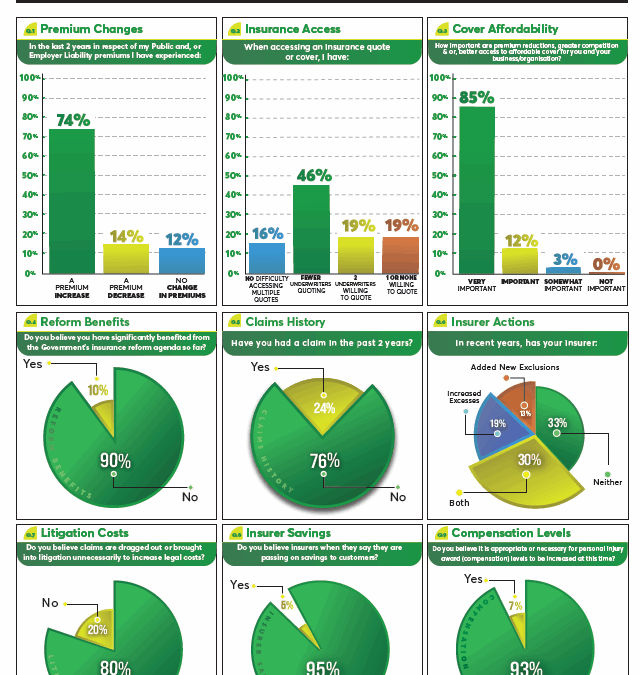
Today the Alliance for Insurance Reform publishes the findings of a significant survey it undertook with small and medium businesses, sports, community and voluntary groups in respect of their liability insurance cover in recent months. It received a very substantial 775 responses, and the findings are striking:
· Almost three quarters of respondents have seen their premium rise in the last two years, notwithstanding recent government reforms. It should also be noted that these increases are occurring at a time when the volume of claims is reducing, awards are coming down and insurance companies are making record profits.[1]
· One in five organisations have only one underwriter willing to provide insurance cover. This is a perilous state for them to be in, and we need to see rapid delivery of the government’s commitments to increase competition in the liability insurance market.
· 90% of respondents said they have not benefited from the government’s action plan on insurance reform. The last government undertook an extensive programme of reform, and it must be galling for them to see the benefits of these reforms not being shared with policyholders.
· 67% of policyholders have seen added exclusions, increased excesses or both in recent years. This essentially means people are now paying more and getting less.
· 76% of respondents said they have not had a claim in the past 2 years.
· Four out of five people believed claims were unnecessarily extended by the legal profession to increase their fees. We know from a recent Central Bank report[2] that liability awards are the same on average whether a claimant settles at the Injuries Resolution Board or via litigation. It is therefore astonishing that almost 70% of claims (equating to almost 90% of the overall value of liability claims) continue to be settled in litigation. This is an area that requires much greater examination.
· 95% of respondents did not believe insurers when they said they were passing on savings to customers.
· 93% of respondents said they did not believe it was appropriate or necessary for personal injury awards to be increased at this time. The Minister for Justice is currently poised to recommend a 17% increase in awards to Cabinet in the coming weeks, notwithstanding the fact that awards in Ireland are higher than virtually anywhere else, and he is about to do so in the context of ever rising insurance premiums. It is obvious to everyone what will happen to premiums if this increase goes ahead.
Speaking about today’s survey results grocery store owner and Alliance board member, Flora Crowe said: ‘the Government risks being seen as ‘completely out of touch’, if it approves an increase in awards that will see insurance premiums skyrocket – do they not know people just can’t afford it’.
‘It is only a few years ago that the Personal Injuries Commission found that awards here were 440% higher here than in England. The Personal Injury Guidelines brought them down a bit, but premiums have continued to go up. If they increase awards now, the Minister for Justice is guaranteeing that my premium goes up considerably. Motor insurance costs are certain to keep going up as well; I just don’t see how Ministers and TDs can support it.’
‘I run a small business like many other people, and the cost of business is already the biggest concern facing us and now the government looks set to make it worse. Where is the SME test in all of this? The increase will undo so much of the good work done on insurance reform by the last government. The findings in this survey couldn’t be clearer – I hope common sense will prevail, but I am very worried.’
The Alliance for Insurance Reform brings together 47 civic and business organisations from across Ireland including the Federation of Irish Sport, representing over 55,000 members, 700,000 employees, 614,000 volunteers and 374,000 students in highlighting the negative impact of persistently high premiums and calling for real reforms that will quickly reduce liability and motor insurance premiums to affordable levels and keep them that way.
FOR FURTHER INFORMATION CONTACT: contact@insurancereform.ie
1. Premium increase will not be limited to businesses, sports and community groups. Motorists will also see their premiums rise sharply in a market where premiums have been on an upward trend for at least 18 months. The Central Bank NCID report for the first half of 2024 showed a sharp rise in motor insurance premiums of 9% in just the first 6 months of last year. CSO data has tracked increases in the cost of car insurance every month since then.
2. The most recent NCID liability report from the Central Bank published in March 2025 found that premiums increased by 4% in 2023 and have increased by 17% since 2020, despite a range of government reforms. The liability market has also proven highly profitable for insurers, showing an operating profit of 13% in 2023 (2.5 times greater than international norms).
3. The same NCID liability report showed that average legal costs are less than €1,000 for cases finalised at the Injuries Board but over €23,000 once it enters into litigation, whilst awards for claimants were the same in either channel (also at €23,000). Almost 70% of cases settle in the litigation channel.
4. If we continually review upwards personal injury awards every three years and it takes two and a half years to settle a claim at the Injuries Board, claimants will simply hold on a few months and bring their case into litigation. Not only will awards increase but legal fees will increase the cost of claims exponentially.
5. The Alliance for Insurance Reform brings together 47 civic and business organisations from across Ireland, representing over 55,000 members, 700,000 employees, 614,000 volunteers and 374,000 students in highlighting the negative impact of persistently high premiums and calling for real reforms that will quickly reduce liability and motor insurance premiums to affordable levels and keep them that way.
6. Please see below (and attached) infographic of today’s survey findings:
May 29, 2025
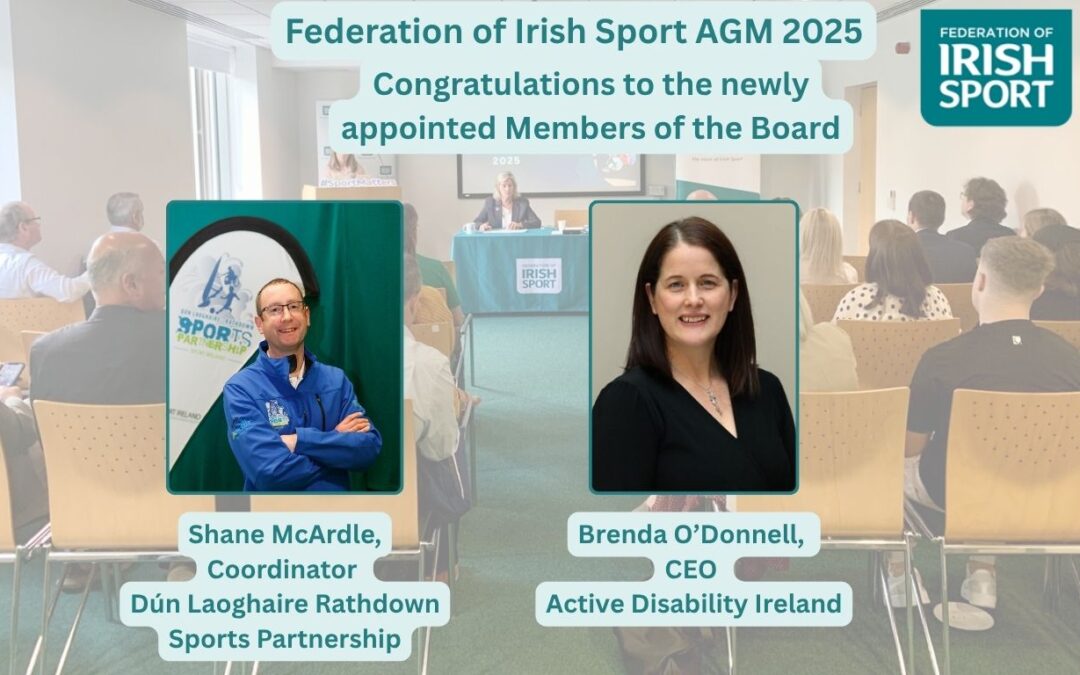
The Federation of Irish Sport hosted their Annual General Meeting on Thursday 22nd May which saw the addition of two new Board Directors, Brenda O’Donnell CEO Active Disability Ireland and Shane McArdle Coordinator Dún Laoghaire Rathdown Sports Partnership. The Chair thanked outgoing Board Member Graham Russell Head of Louth Sports for his 6 years of service.
Brenda has always worked and being involved in disability sport and physical activity, creating equal sporting and recreational opportunities for individuals with disabilities. She is a graduate from the Institute of Technology Tralee, (now Munster Technological University) and in 2001 graduated with a BSc in Health, Fitness and Leisure Studies. Through her role Brenda aims to increase the profile of Active Disability Ireland, building on the strong foundations and its vital partnerships across the sport, disability, health and community sectors. She promises to continue the strong connections and relationships that have been established over the years with all of Active Disability Ireland’s funding and supporting partners. Working closely with all team members within Active Disability Ireland her role will focus on operational effectiveness aligned to the organisations strategy, continued leadership through example under good governance, continued Influencing and challenge of local and national policy and strengthened support of the creation of choice and opportunity through direct engagement with people with disabilities.
A graduate of both DIT Cathal Brugha Street and Smurfit Business School, Shane has been working in the sports and leisure industry for over 23 years in a variety of roles and sectors. His previous roles include those in the fitness industry, leisure consultancy and sports facility management. Having taken the role of Coordinator in Dun Laohaire Rathdown Sports Partnership in 2008, he now collaborates with a range of partner organisations to increase participation in sport and physical activity across all age groups and abilities in the County. While a large proportion of his time would be spent in leadership and planning, he is also heavily involved in managing a range of events and initiatives around getting people out and active in whatever form that takes. Shane is also a long-standing Director in Dun Laoghaire Rathdown Volunteer Centre.
May 29, 2025
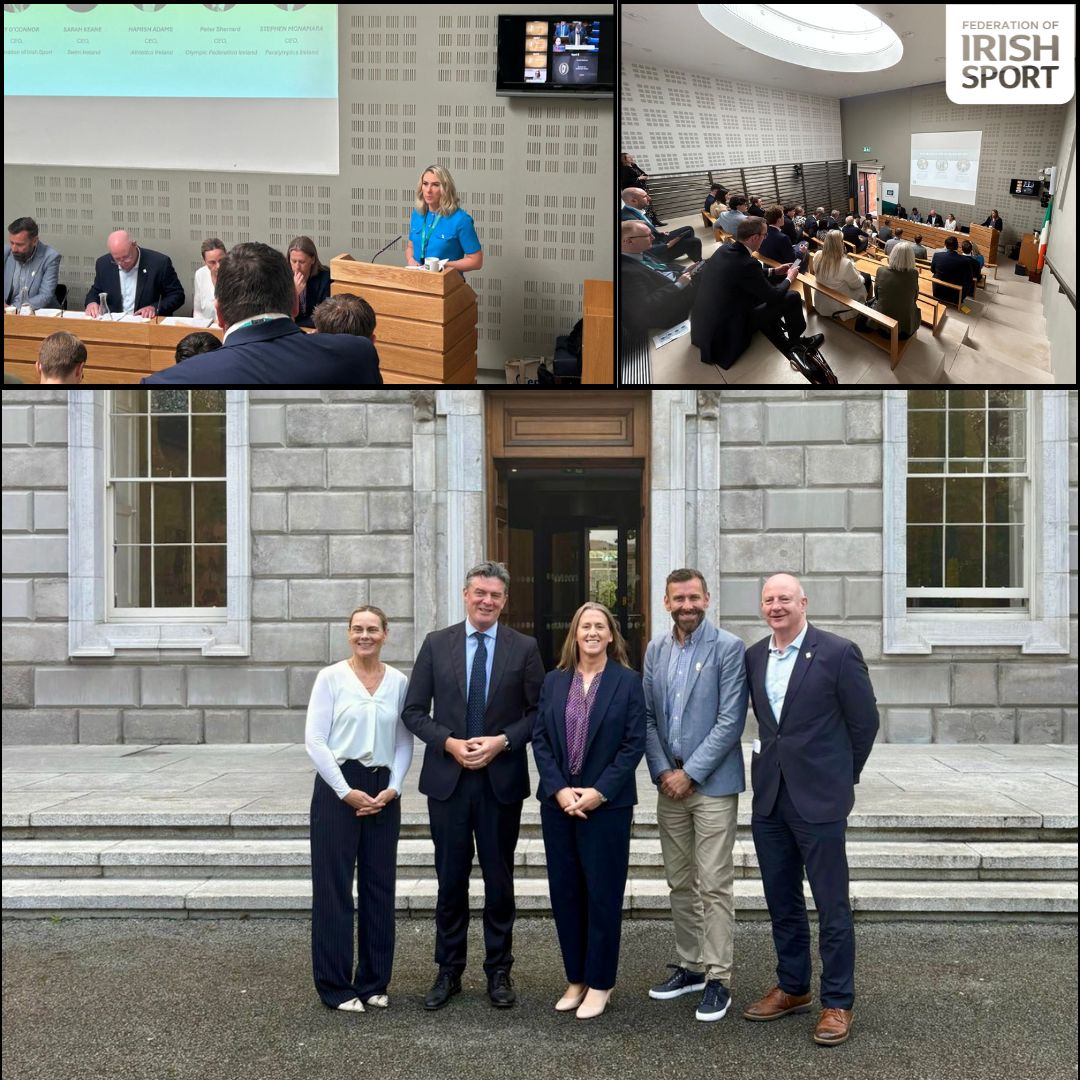
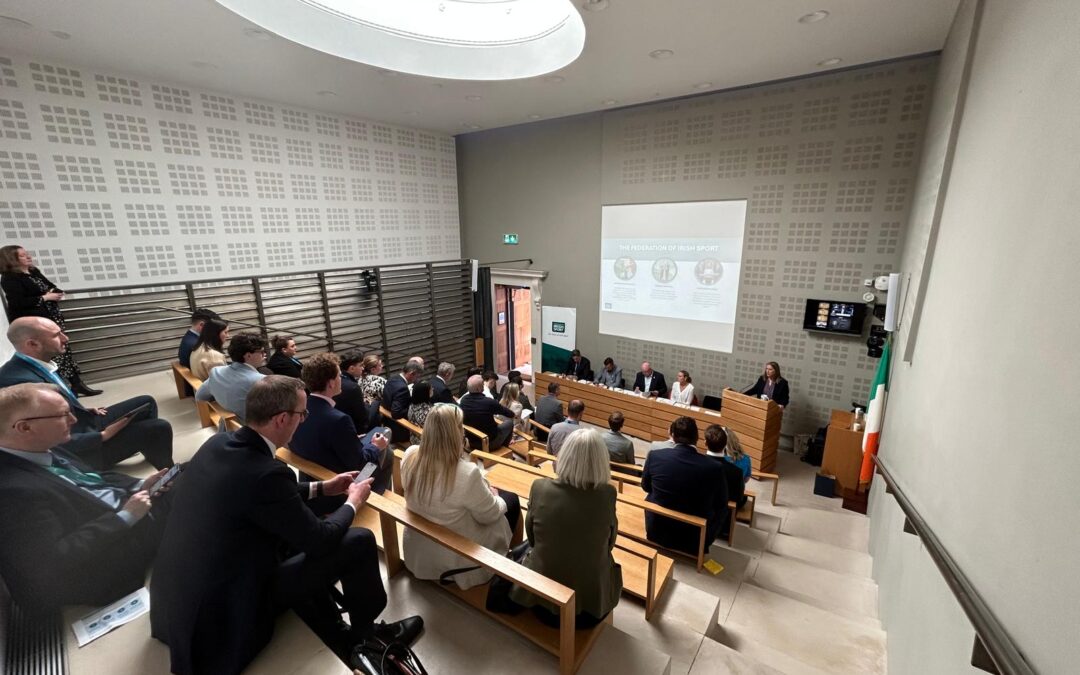
The Federation of Irish Sport hosted an engaging high-level briefing in the AV Room of Leinster House on Wednesday 28 May, aimed at informing elected representatives of the critical structural and financial challenges facing Ireland’s sporting sector. The event hosted by Senator Evanne Ní Chuilinn was very well attended by elected public representatives and their officials.
Following the briefing Deputy James Geoghegan TD raised the question of investment in sport with Minister McConalogue.
FIS called for:
- An introduction of guaranteed year-on-year increases in newly proposed multi-annual funding model
- An establishment of a national pay framework for the professional sports workforce
- An implementation of a new1% betting levy to fund grassroot sport programmes
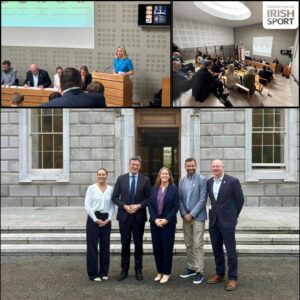
Sport in Ireland delivers significant public, economic, and social value, the Federation outlined a series of policy recommendations to ensure the sustainability and growth of the sector. Key voices from Ireland’s sports leadership who supported the call for action, included:
- Sarah Keane, CEO, Swimming Ireland
- Hamish Adams, CEO, Athletics Ireland
- Peter Sherrard, CEO, Olympic Federation of Ireland
- Stephen McNamara, CEO, Paralympics Ireland
Current State of Play
The current core funding model has been eroded by inflation and rising compliance costs, limiting the capacity of sports organisations to plan and scale. While Budget 2025’s 4% increase was a welcome step, it remains insufficient. The Federation welcomes the Government’s move to multi-annual funding from 2026 but insists that this funding must grow progressively to ensure stability and impact.
The Irish sports sector relies on a professional workforce. To sustain and grow the sector’s workforce, the Federation is calling for:
- A national pay framework
- A Sports Exemption Scheme, modelled on the Artists Exemption scheme.
In regard to the implementation of a new 1% betting levy to fund grassroot sport programmes, there are examples of European approaches to this, namely in France and Portugal, where levies directly fund sport infrastructure and programming at all levels. In 2023, the existing 2% betting levy generated €103 million. A new 1% levy could provide an additional €50 million annually for sport development and participation.
Federation of Irish Sport CEO Mary O’Connor said: “In order to secure the future of sport in Ireland and ensure we reach the 60% participation target set out in the National Sports Policy, we need decisive and sustained action from Government. We are calling for annual increases in core funding to reflect inflation and the real costs of the business of sport. A new 1% betting levy could provide an estimated additional €50 million annually for sport development and participation. We also need to recognise and reward the workforce that keeps our sector moving by introducing standardised pay scales and implementing a Sports Volunteer Exemption Scheme. We welcomed the opportunity provided to talk directly to elected public representatives today and I would like to thank Senator Ní Chuilinn for hosting this important sector representation and my colleagues in sport for their contribution.”
May 28, 2025
Sunday Independent, 25th May 2025, by Cliona Foley
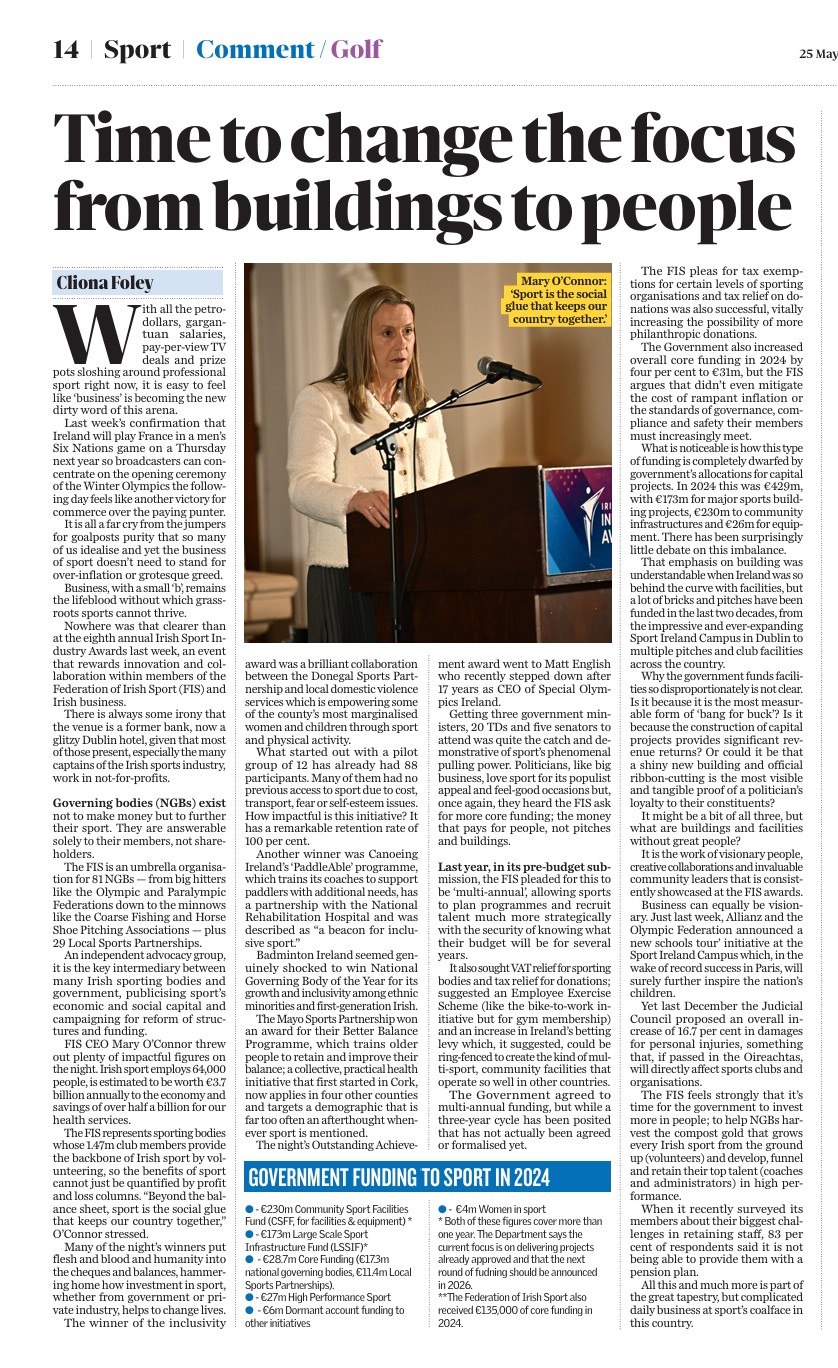
With all the petrodollars, gargantuan salaries, pay-per-view TV deals and prize pots sloshing around professional sport right now, it is easy to feel like business’ is becoming the new dirty word of this arena. Last week’s confirmation that Ireland will play France in a men’s Six Nations game on a Thursday next year so broadcasters can concentrate on the opening ceremony of the Winter Olympics the following day feels like another victory for commerce over the paying punter. It is all a far cry from the jumpers for goalposts purity that so many of us idealise and yet the business of sport doesn’t need to stand for over-inflation or grotesque greed.
Business, with a small ‘b’, remains the lifeblood without which grassroots sports cannot thrive. Nowhere was that clearer than at the eighth annual Irish Sport Industry Awards last week, an event that rewards innovation and collaboration within members of the Federation of Irish Sport (FIS) and Irish business.
There is always some irony that the venue is a former bank, now a glitzy Dublin hotel, given that most of those present, especially the many captains of the Irish sports industry, work in not-for-profits.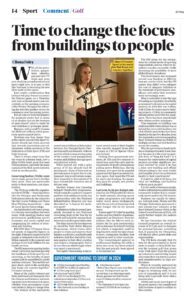
Governing bodies (NGBs) exist not to make money but to further their sport. They are answerable solely to their members, not share holders. The FIS is an umbrella organisation for 81 NGBs — from big hitters like the Olympic and Paralympic Federations down to the minnows like the Coarse Fishing and Horse
Shoe Pitching Associations — plus 29 Local Sports Partnerships. An independent advocacy group, it is the key intermediary between many Irish sporting bodies and government, publicising sport’s economic and social capital and campaigning for reform of structures and funding.
FIS CEO Mary O’Connor threw out plenty of impactful figures on the night. Irish sport employs 64,000 people, is estimated to be worth €3.7 billion annually to the economy and savings of over half a billion for our health services. The FIS represents sporting bodies whose 1.47m club members provide the backbone of Irish sport by volunteering, so the benefits of sport cannot just be quantified by profit and loss columns. “Beyond the balance sheet, sport is the social glue that keeps our country together,” O’Connor stressed.
Many of the night’s winners put flesh and blood and humanity into the cheques and balances, hammering home how investment in sport, whether from government or private industry, helps to change lives. The winner of the inclusivity award was a brilliant collaboration between the Donegal Sports Partnership and local domestic violence services which is empowering some of the county’s most marginalised women and children through sport and physical activity.
What started out with a pilot group of 12 has already had 88 participants. Many of them had no previous access to sport due to cost, transport, fear or self-esteem issues. How impactful is this initiative? It has a remarkable retention rate of 100 per cent. Another winner was Canoeing Ireland’s ‘PaddleAble’ programme, which trains its coaches to support paddlers with additional needs, has a partnership with the National Rehabilitation Hospital and was described as “a beacon for inclusive sport.”
Badminton Ireland seemed genuinely shocked to win National Governing Body of the Year for its growth and inclusivity among ethnic minorities and first-generation Irish.
The Mayo Sports Partnership won an award for their Better Balance Programme, which trains older people to retain and improve their balance; a collective, practical health initiative that first started in Cork, now applies in four other counties and targets a demographic that is far too often an afterthought when
ever sport is mentioned.
The night’s Outstanding Achievement award went to Matt English who recently stepped down after 17 years as CEO of Special Olympics Ireland. Getting three government ministers, 20 TDs and five senators to attend was quite the catch and demonstrative of sport’s phenomenal pulling power. Politicians, like big
business, love sport for its populist appeal and feel-good occasions but, once again, they heard the FIS ask for more core funding; the money that pays for people, not pitches and buildings.
Last year, in its pre-budget submission, the FIS pleaded for this to be ‘multi-annual’, allowing sports to plan programmes and recruit talent much more strategically with the security of knowing what their budget will be for several years. It also sought VAT relief for sporting bodies and tax relief for donations;
suggested an Employee Exercise Scheme (like the bike-to-work initiative but for gym membership) and an increase in Ireland’s betting levy which, it suggested, could be ring-fenced to create the kind of multi-sport, community facilities that operate so well in other countries.
The Government agreed to multi-annual funding, but while a three-year cycle has been posited that has not actually been agreed or formalised yet.
The FIS pleas for tax exemptions for certain levels of sporting organisations and tax relief on donations was also successful, vitally increasing the possibility of more philanthropic donations. The Government also increased overall core funding in 2024 by four per cent to €31m, but the FIS argues that didn’t even mitigate the cost of rampant inflation or the standards of governance, compliance and safety their members must increasingly meet. What is noticeable is how this type of funding is completely dwarfed by government’s allocations for capital projects. In 2024 this was €429m, with €173m for major sports building projects, €230m to community infrastructures and €26m for equipment. There has been surprisingly little debate on this imbalance.
That emphasis on building was understandable when Ireland was so behind the curve with facilities, but a lot of bricks and pitches have been funded in the last two decades, from the impressive and ever-expanding Sport Ireland Campus in Dublin to multiple pitches and club facilities across the country.
Why the government funds facilities so disproportionately is not clear. Is it because it is the most measurable form of ‘bang for buck’? Is it because the construction of capital projects provides significant revenue returns? Or could it be that a shiny new building and official ribbon-cutting is the most visible and tangible proof of a politician’s loyalty to their constituents?
It might be a bit of all three, but what are buildings and facilities without great people? It is the work of visionary people, creative collaborations and invaluable
community leaders that is consistently showcased at the FIS awards. Business can equally be visionary. Just last week, Allianz and the Olympic Federation announced a new schools tour’ initiative at the Sport Ireland Campus which, in the wake of record success in Paris, will surely further inspire the nation’s children. Yet last December the Judicial Council proposed an overall increase of 16.7 per cent in damages for personal injuries, something that, if passed in the Oireachtas, will directly affect sports clubs and organisations.
The FIS feels strongly that it’s time for the government to invest more in people; to help NGBs harvest the compost gold that grows every Irish sport from the ground up (volunteers) and develop, funnel and retain their top talent (coaches and administrators) in high performance. When it recently surveyed its members about their biggest challenges in retaining staff, 83 per cent of respondents said it is not being able to provide them with a pension plan.
All this and much more is part of the great tapestry, but complicated daily business at sport’s coalface in this country.
GOVERNMENT FUNDING TO SPORT IN 2024
●- €230m Community Sport Facilities Fund (CSFF, for facilities & equipment) *
● ●- €173m Large Scale Sport Infrastructure Fund (LSSIF)*
● ● – €28.7m Core Funding (€17.3m national governing bodies, €11.4m Local Sports Partnerships).
● ●- €27m High Performance Sport
● ● – €6m Dormant account funding to other initiatives
● ●- €4m Women in sport
* Both of these figures cover more than one year. The Department says the current focus is on delivering projects already approved and that the next
round of funding should be announced in 2026.
**The Federation of Irish Sport also received €135,