
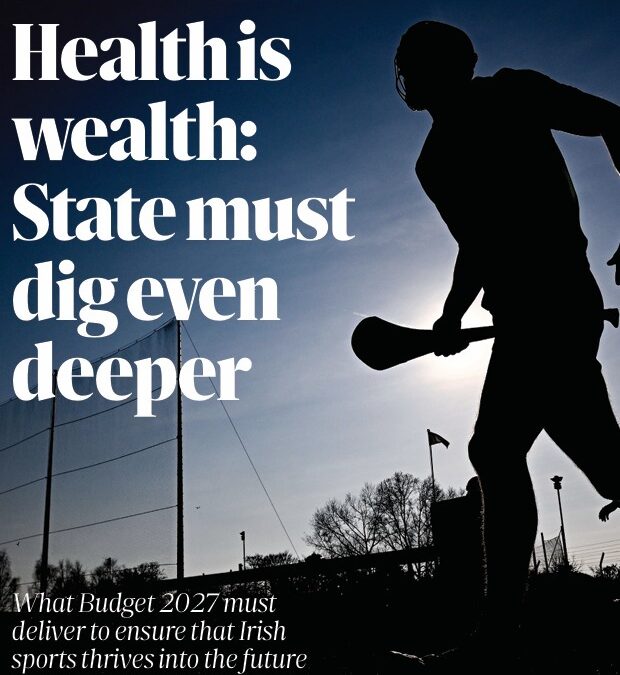
What Budget 2027 must deliver to ensure that Irish sport thrives into the future
By Mary O’Connor, Chief Executive Officer Federation of Irish Sport
Every single euro invested in core sports participation in Ireland functions as an incredibly efficient form of frontline health.
By keeping people active, sport directly reduces future State spending on chronic illness, mental health services, and cardiovascular care. Treating overweight and obesity in 2025 cost the HSE an estimated €1 billion.
The 2026 OECD report, The Health and Economic Benefits of Tackling Non-Communicable Diseases: Ireland, highlights that non-communicable diseases cause 51 per cent of premature deaths in our country. The OECD explicitly identifies sports funding as a premier preventive tool. Scaling up our physical activity infrastructure has the potential to save €405m annually in healthcare costs while boosting national GDP by 1.4 per cent.
When an Irish athlete stands on the podium with a European or World gold medal, the success is celebrated by the entire nation. The athlete’s journey began long before the lights and cameras. Every elite competitor is built in a local community supported by a grassroots army. This massive network of activities, games, competitions, training, social connection, volunteerism and facility development is quietly powered by National Governing Bodies (NGBs), Local Sports Partnerships (LSPs) and their members across Ireland.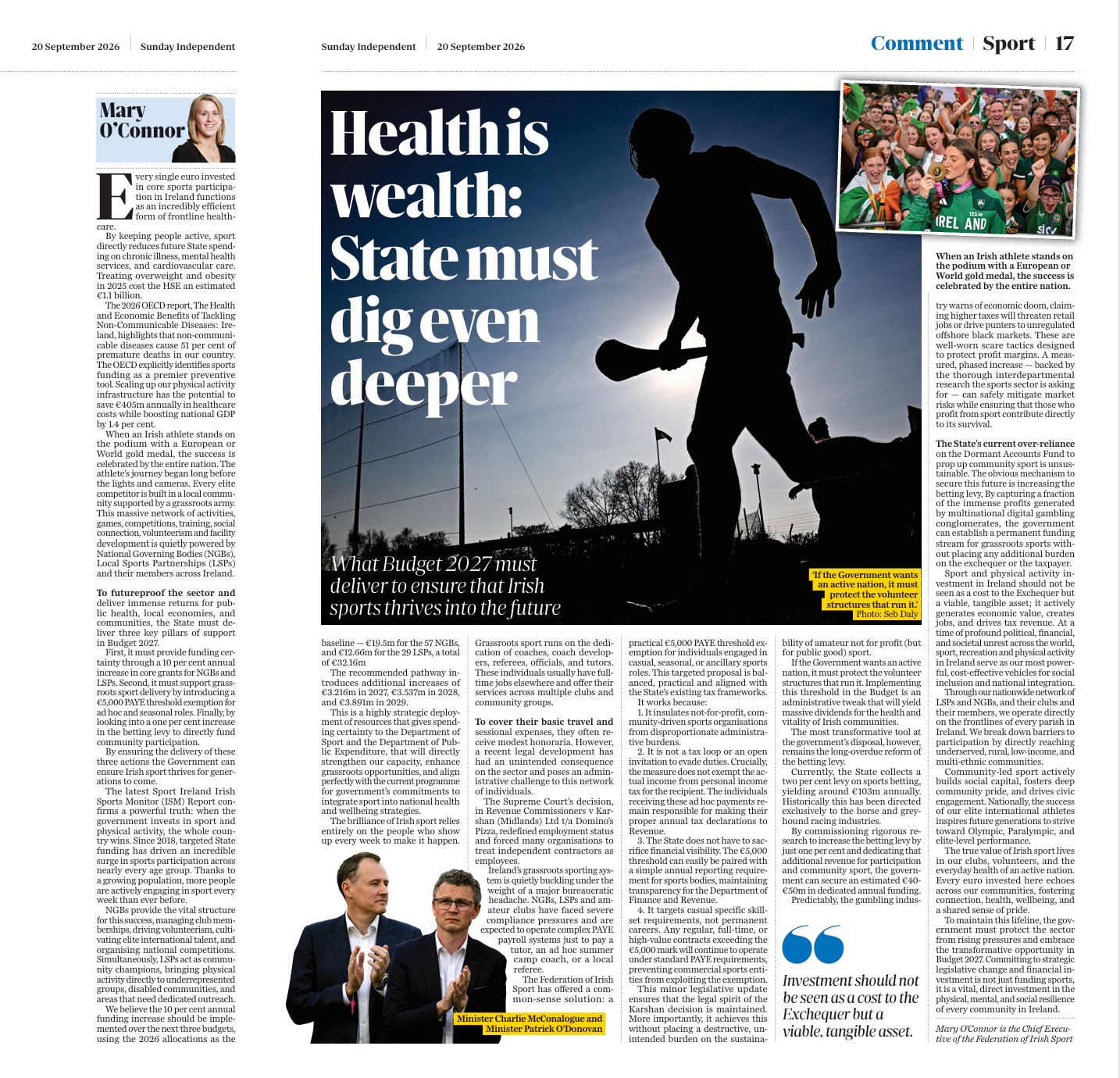
To futureproof the sector and deliver immense returns for public health, local economies, and communities, the State must deliver three key pillars of support in Budget 2027.
First, it must provide funding certainty through a 10 per cent annual increase in core grants for NGBs and LSPs. Second, it must support grassroots sport delivery by introducing a €5,000 PAYE threshold exemption for ad hoc and seasonal roles. Finally, by looking into a one per cent increase in the betting levy to directly fund community participation.
By ensuring the delivery of these three actions, the Government can ensure Irish sport thrives for generations to come.
The latest Sport Ireland Irish Sports Monitor (ISM) Report confirms a powerful truth: when the government invests in sport and physical activity, the whole country wins. Since 2018, targeted State funding has driven an incredible surge in sports participation across nearly every age group. Thanks to a growing population, more people are actively engaging in sport every week than ever before.
NGBs provide the vital structure for this success, managing club memberships, driving volunteerism, cultivating elite international talent, and organising national competitions. Simultaneously, LSPs act as community champions, bringing physical activity directly to underrepresented groups, disabled communities, and areas that need dedicated outreach.
We believe the 10 per cent annual funding increase should be implemented over the next three budgets, using the 2026 allocations as the baseline — €19.5m for the 57 NGBs, and €12.66m for the 29 LSPs, a total of €32.16m.
The recommended pathway introduces additional increases of €3.216m in 2027, €3.537m in 2028, and €3.891m in 2029.
This is a highly strategic deployment of resources that gives spending certainty to the Department of Sport and the Department of Public Expenditure, that will directly strengthen our capacity, enhance grassroots opportunities, and align perfectly with the current programme for government’s commitments to integrate sport into national health and wellbeing strategies.
The brilliance of Irish sport relies entirely on the people who show up every week to make it happen. Grassroots sport runs on the dedication of coaches, coach developers, referees, officials, and tutors. These individuals usually have full-time jobs elsewhere and offer their services across multiple clubs and community groups.
To cover their basic travel and sessional expenses, they often receive modest honoraria. However, a recent legal development has had an unintended consequence on the sector and poses an administrative challenge to this network of individuals.
The Supreme Court’s decision, in Revenue Commissioners v Karshan (Midlands) Ltd t/a Domino’s Pizza, redefined employment status and forced many organisations to treat independent contractors as employees.
Ireland’s grassroots sporting system is quietly buckling under the weight of a major bureaucratic headache. NGBs, LSPs and amateur clubs have faced severe compliance pressures and are expected to operate complex PAYE payroll systems just to pay a tutor, an ad hoc summer camp coach, or a local official.
The Federation of Irish Sport has offered a common-sense solution: a practical €5,000 PAYE threshold exemption for individuals engaged in casual, seasonal, or ancillary sports roles. This targeted proposal is balanced, practical and aligned with the State’s existing tax frameworks.
It works because:
- It insulates not-for-profit, community-driven sports organisations from disproportionate administrative burdens.
- It is not a tax loophole or an open invitation to evade duties. Crucially, the measure does not exempt the actual income from personal income tax for the recipient. The individuals receiving these ad hoc payments remain responsible for making their proper annual tax declarations to Revenue.
- The State does not have to sacrifice financial visibility. The €5,000 threshold can easily be paired with a simple annual reporting requirement for sports bodies, maintaining transparency for the Department of Finance and Revenue.
- It targets casual, specific skill-set requirements, not permanent careers. Any regular, full-time, or high-value contracts exceeding the €5,000 mark will continue to operate under standard PAYE requirements, preventing commercial sports entities from exploiting the exemption.
This minor legislative update ensures that the legal spirit of the Karshan decision is maintained. More importantly, it achieves this without placing a destructive, unintended burden on the sustainability of amateur not-for-profit (but for public good) sport.
If the Government wants an active nation, it must protect the volunteer structures that run it. Implementing this threshold in the Budget is an administrative tweak that will yield massive dividends for the health and vitality of Irish communities.
The most transformative tool at the government’s disposal, however, remains the long-overdue reform of the betting levy.
Currently, the State collects a two per cent levy on sports betting, yielding around €103m annually. Historically this has been directed exclusively to the horse and greyhound racing industries.
By commissioning rigorous research to increase the betting levy by just one percent and dedicating that additional revenue for participation and community sport, the government can secure an estimated €40–€50m in dedicated annual funding.
Predictably, the gambling industry warns of economic doom, claiming higher taxes will threaten retail jobs or drive punters to unregulated offshore black markets. These are well-worn scare tactics designed to protect profit margins. A measured, phased increase — backed by the thorough interdepartmental research the sports sector is asking for — can safely mitigate market risks while ensuring that those who profit from sport contribute directly to its survival.
The State’s current over-reliance on the Dormant Accounts Fund to prop up community sport is unsustainable. The obvious mechanism to secure this future is increasing the betting levy. By capturing a fraction of the immense profits generated by multinational digital gambling conglomerates, the government can establish a permanent funding stream for grassroots sports without placing any additional burden on the exchequer or the taxpayer.
Sport and physical activity investment in Ireland should not be seen as a cost to the Exchequer but a viable, tangible asset; it actively generates economic value, creates jobs, and drives tax revenue. At a time of profound political, financial, and societal unrest across the world, sport, recreation and physical activity in Ireland serve as our most powerful, cost-effective vehicles for social inclusion and national integration.
Through our nationwide network of LSPs and NGBs, and their clubs and their members, we operate directly on the frontlines of every parish in Ireland. We break down barriers to participation by directly reaching underserved, rural, low-income, and multi-ethnic communities.
Community-led sport actively builds social capital, fosters deep community pride, and drives civic engagement. Nationally, the success of our elite international athletes inspires future generations to strive toward Olympic, Paralympic, and elite-level performance.
The true value of Irish sport lives in our clubs, volunteers, and the everyday health of an active nation. Every euro invested here echoes across our communities, fostering connection, health, wellbeing, and a shared sense of pride.
To maintain this lifeline, the government must protect the sector from rising pressures and embrace the transformative opportunity in Budget 2027. Committing to strategic legislative change and financial investment is not just funding sports, it is vital, direct investment in the physical, mental, and social resilience of every community in Ireland.