Sep 18, 2024
Federation of Irish Sport Launches Pre-Budget Submission for Budget 2025
- Submission calls for Multi-Annual Core Funding Increase, Reforms to Taxation Policies and increase in Betting Levy to Support Growth of Irish Sport & Physical Activity
- Click here to read full submission
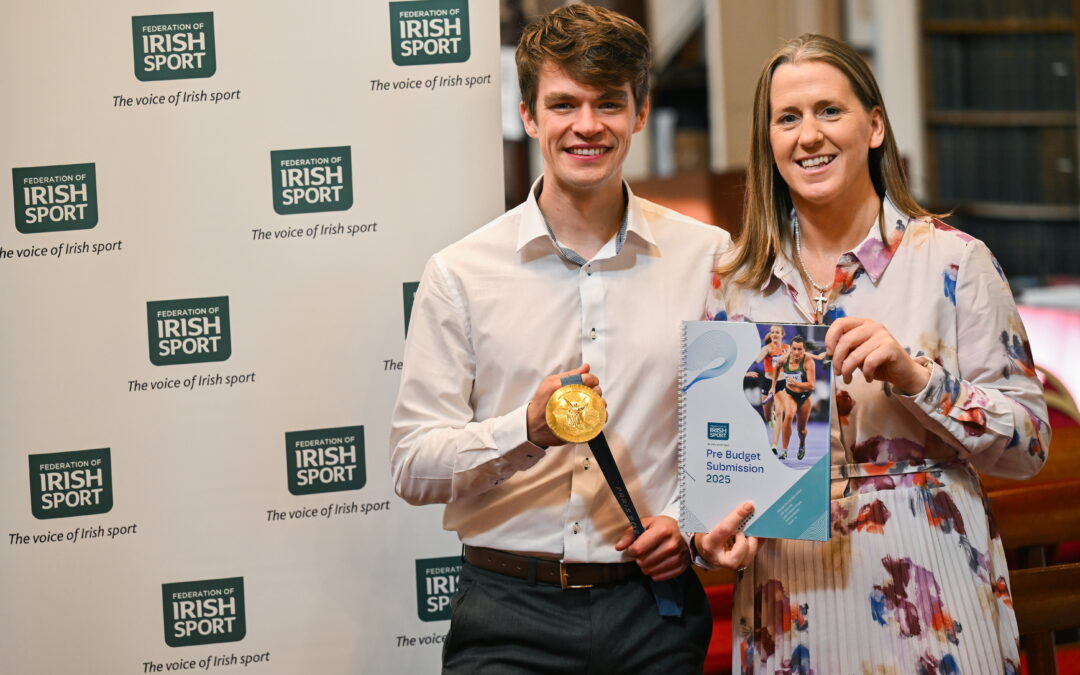
Double Olympic gold medallist Fintan McCarthy today joined the Federation of Ireland Sport along with National Governing Bodies and Local Sports Partnerships from across Ireland in urgently calling for greater investment in Irish sport in Budget 2025.
McCarthy was the special guest of the Federation of Irish Sport at the launch of its Pre-Budget Submission for Budget 2025, an event attended by elected representatives of Dáil Éireann, Senators, and members of the Federation, which represents 81 National Governing Bodies (NGBs) and 29 Local Sports Partnerships (LSPs).
The Federation has put forward three key “Asks” of the government, with the primary request being for a multi-annual increase in core funding for NGBs and LSPs. Core funding is the heart sporting bodies in Ireland, enabling the creation of programmes and pathways that identify, nurture, and support the sporting heroes of tomorrow. Additional calls for taxation reform and an increase in the betting levy comprise the two other key Asks.
Mary O’Connor, CEO of the Federation of Irish Sport, emphasised the significance of this funding: “Our overall ask in relation to the upcoming budget is for government to increase funding for the core activities which build the base of sport and physical activity in Ireland. We realise that there is much to be financed across many areas in relation to Budget2025, we would however respectfully suggest that additional funding for sport might be found through the proposed changes to taxation under Action 3.7 and an increase in the betting levy for Sport.”
Since the launch of the National Sports Policy in 2018, significant progress has been made in high-performance and sports capital funding. However, core funding for NGBs and LSPs, which is critical for the long-term development of grassroots sport, has lagged behind/not matched/has been eroded by inflation and rising costs. This funding is essential for building programmes, retaining key personnel, and attracting quality coaches and staff.
By adopting a multi-annual funding model, the Federation argues, the government would provide the certainty needed to plan strategically and deliver meaningful long-term outcomes.
“Core funding is used not only to maintain the foundation of these organisations but to strengthen it,” O’Connor added. “All sport in this country starts with the NGBs and LSPs. They build the programmes and nurture the participants who go on to perform at the highest levels on the world stage.”
Mary O’Connor further highlighted the potential of taxation reform: “As we have mentioned previously in our submissions, we believe that changes could be made in existing legislation to the benefit of sport. We also believe that a 1% rise in the betting tax could produce up to €40 million, which could beneficially invest in sport and in programmes aimed at tackling the problems of gambling addiction.”

Jul 15, 2024
Catherine Martin T.D., Minister for Tourism, Culture, Arts, Gaeltacht, Sport and Media, and Thomas Byrne T.D., Minister of State for Sport, Physical Education and the Gaeltacht have reflected on some of the key achievements in the first half of this year, which have helped support the sectors under the remit of the Department. Among key achievements….
- Record funding for high-performance Irish athletes in Olympic and Paralympic year
- Initiatives to recognise the role of women in Irish society
- National Plan for Irish Language Public Services
- Multi-million investment in arts and culture
- Development of new Tourism Policy Framework
Commenting on the first six months of the year, Ministers Martin and Byrne highlighted major funding initiatives vital to the growth and evolution of sectors within their responsibility.
Minister Martin said:
“So far this year, my Department has supported a range of projects and initiatives across all the sectors under its remit. From record funding of €250m in Sports Capital and Equipment, to the world-leading Basic Income for the Arts pilot scheme, to investment in the Gaeltacht and the Irish language on a scale never seen before. I am proud of this Government’s commitment to our tourism industry, to the arts and culture, to sport at all levels, to our native language with the Gaeltacht at its heart, and to developing a robust and trustworthy media sector.
The country’s recent success in international athletics demonstrates the benefits of investment in sport. My Department this year announced a record €25m funding through Sport Ireland in High Performance Sport. This is the highest-ever level of investment in High Performance Sport in Ireland – both for an individual year and for an Olympic/Paralympic cycle. It marks a huge step towards the investment objectives set out in the National Sports Policy 2018-2027.
“Separately, a range of initiatives – both financial and otherwise – have been undertaken to support this country’s rich cultural and artistic traditions. These include the allocation of €6m to deliver artist workspaces nationwide. Research conducted by my Department, and ongoing engagement with the creative and night-time economy sectors, over the last number of years has revealed demand for artist workspaces far outweighs supply, and that there is a widespread shortage of creative spaces such as studios and performance spaces.
“Earlier this year, we launched the Strategy for Language-Based Arts in addition to a financial package of almost €10 million to commence its implementation. This package includes four-year funding of €5.78 million for An Taibhdhearc, Amharclann Náisiúnta na Gaeilge for the period 2024 to 2027 as well as €4.085 million for Oireachtas na Gaeilge for its National Action Plan to develop, strengthen and promote Irish language-based arts across the country in the period 2024-2027. The success of the 35m annual Basic Income for the Arts scheme also continues with weekly payments of €325 to 2,000 artists and creative arts workers
“I published two reviews commissioned following the Government decision to initiate an independent, root and branch examination of RTÉ. The 116 recommendations made by the Expert Advisory Committees are a blueprint for the further reform of our national broadcaster.
“When fully implemented, they will improve the governance of RTÉ, both internally and externally, ensure the culture of RTÉ better reflects the values of public service held by its staff, and improve both the industrial relations landscape and human resources processes and procedures within RTÉ. The recommendations point the way to a more inclusive, transparent and accountable RTÉ, one that truly has the character of a public service.”
Minister Martin continued: “Our investment in our film and television industry continues to pay dividends, from small, independent productions to Oscar-winners and streaming blockbusters. I was delighted to be able to congratulate Cillian Murphy on his Academy Award. He represents the pinnacle of an industry my Department is proud to support.
“In recent years there has been a growing recognition of the need to address the under-representation of women’s contributions to the State’s political, scientific, social and cultural history.
“Accordingly, this year I established a new advisory committee to focus on women and women’s stories in the national cultural collections.”
With regard to tourism, Minister Martin stated: “We continue to provide strong support to the tourism sector in its journey towards full recovery post-Covid. Earlier this year we undertook a public consultation process on our new Tourism Policy Framework which will shape how tourism develops in a sustainable way in Ireland in the period to 2030. I expect to publish that new policy in the coming months. I also had the opportunity to engage with the sector both at Meitheal in Killarney and at two meetings of the Hospitality and Tourism Forum held, the most recent of which I chaired. This engagement with the sector is vital to building a sustainable future for tourism in Ireland.
“The capital development pipeline for tourism remains open, and I was really pleased to open the new Queen Maeve Square in Sligo, which has transformed the space into an attractive public square and orientation hub that will undoubtedly attract both national and international visitors.”
Minister Martin also highlighted ongoing north/south cooperation in tourism which continues to deepen with the resumption of the North-South Ministerial Council – which she attended along with cabinet colleagues in April.
“At the North-South Ministerial Council Tourism Sectoral in June I agreed with Minister Conor Murphy to the establishment of a Joint Strategic Coordination Group to identify and examine opportunities that will support the sustainable development of the tourism sector across the island.”
Minister Byrne, said: “As a Government, we are delivering record budgets for sport, as we work to provide everyone, of every ability, with an opportunity to participate in sport and physical activity. Last month, we confirmed that a record €250 million will be available for the Sports Capital and Equipment Programme, representing a 50% increase in funding when compared to the last round of allocations in 2020. We will see the largest-ever investment in sports facilities when Sports Capital and Equipment Programme allocations are announced this Autumn.
“In addition, we launched a new €120 million round of the Large Scale Sport Infrastructure Fund for applications in April, and there will be a strong focus on deliverability as we assess the applications we received following the deadline for applications on 1 July.
“I have been proud to oversee the introduction and publication of the new Similar Access Requirement, which is designed to ensure that whenever sports facilities are publicly funded, women and men enjoy must enjoy similar access to those sports facilities.
“From the grassroots to the boardroom, we want to see women’s participation in sport supported at every level. Recently, we announced a record €4 million for programmes designed to get more women involved in sport. We are also seeing a significant increase of women in sport leadership roles, with the overall percentage of women on sport boards standing at 45% in April 2024, compared to 29% in 2020. Under a new rule that has been introduced, 50% of Government funding will be withheld until 40% gender representation on national sport boards and Local Sports Partnerships is reached.
“In line with the Programme for Government target of reaching 60% overall participation in sport by 2027, I launched a new ‘Participation Nation Outdoor Fund’ in May, which is designed to spur physical activity in local community settings by supporting Local Sports Partnerships with the development of barrier-free sport projects on publicly-accessible land.
“On many occasions, Ireland has done itself proud when it comes to hosting major international sports events, most recently when our capital city welcomed football fans from across Europe and beyond in May for the 2024 UEFA Europa League Final.
“As we look forward to cheering on Team Ireland at the Olympic and Paralympic Games later this summer, I am glad to note this Government’s record in investing over €89 million in this Paris Olympic-Paralympic cycle compared to €59 million invested in the Tokyo Olympic-Paralympic cycle.
Minister Byrne continued: “Since my appointment as Minister of State for the Gaeltacht in April, I have been delighted to advance many priority areas. Recently, we announced the appointment of a new Chair of Údarás na Gaeltachta and in looking ahead, I look forward to publishing the Údarás na Gaeltachta (Amendment) Bill and introducing this important piece of legislation to the Houses of the Oireachtas before the Summer recess.
“The resumption of meetings of the North South Ministerial Council Language Body meeting is a development I greatly welcome and I was delighted to meet with Minister for Communities, Gordon Lyons MLA, and Junior Minister at the Executive Office, Aisling Reilly MLA, at the NSMC North South Secretariat Office in Armagh, in late May, where we engaged with relevant stakeholders.
“I was very glad to recently announce significant progress in the implementation of the Official Languages Acts, with the commencement of provisions allowing for a new Placenames Committee to be appointed and for jury summons to be issued bilingually.
“On 19 June, the first National Plan for Irish Language Public Services was submitted to me and within 3 months of this date, we will see the plan submitted to Government for approval. I am determined to see the National Plan for Irish Language Public Services act as an effective roadmap towards meeting the legislative requirement to have at least 20% of the staff recruited to public bodies competent in Irish, by 31 December 2030.”
Some of the key measures introduced to date in 2024 to help support the Tourism, Culture, Arts, Gaeltacht, Sport and Media sectors include:
TOURISM
· New Chief Executive Officer and board members appointed to Tourism Ireland
Opinions Sought on the Future of Irish Tourism
· Just Transition, first phase funding of €24M allocated by Fáilte Ireland
· Work continues on the Shared Island Tourism Brand Collaboration Project which aims to create greater links between two iconic coastal routes
· North South Ministerial Council – Minister Martin affirms commitment to work together with all stakeholders towards achieving a sustainable tourism sector
· Targeted supports delivered to tourism businesses most affected by accommodation stock displacement
· The continuous provision of capital funding to ensure the sustainable development of tourism product across the regions.
CULTURE AND ARTS
· €6 million funding to deliver artist workspaces nationwide
· Creative Ireland awards over €1.2 million to Creative Health and Wellbeing Projects
· Works commence on €37m redevelopment of the Archive Repository at the National Archives
· Department drive to make Ireland’s nightlife inclusive for people with disabilities
· Cruinniú na nÓg 2024 launches over 1,000 free creative activities for young people
· Bonar Law Collection acquired by National Library of Ireland
· New exhibition chronicling key aspects of Irish life over the last 100 years
· Minister Martin welcomes allocation of €8.6m in funding through Sound and Vision Scheme
· New advisory committee to focus on women and women’s stories in the national cultural collections
· Launch of Ireland’s Representation at the 2024 Venice Biennale
· Irish poets and politicians among treasure trove of new records released online
· Opening Night of Zeitgeist Irland 24 – a year-long programme of Irish arts and culture across Germany in 2024
· Over €1.2 million in funding announced for Culture Ireland’s promotion of Irish arts globally
· Arts Sector gathers to discuss Status of the Artist in Ireland & results from first year of the Basic Income for the Arts pilot
· Crawford Art Gallery redevelopment project to progress to tender
· Minister Michael McGrath and Minister Catherine Martin highlight recent Section 481 improvements at Ardmore Studios visit
GAELTACHT
· New arts strategy and funding package of €20 million announced for the Gaeltacht and for the Irish language in the community
· Minister Byrne announces increase in daily allowances for Gaeltacht families and hostels under Scéim na bhFoghlaimeoirí Gaeilge
· North South Ministerial Council approves appointment of CEO of Foras na Gaeilge
· Tech funding of over €2m for Kinia to develop STEAM skills through Irish
· New Chair of Údarás na Gaeltachta
· €600,000 in funding approved for the Conradh na Gaeilge Ciste Spreagtha 2024 – 2026
· Publication of the Údarás na Gaeltachta Bill 2024
· Significant progress made on implementation of the Official Languages Acts
SPORT
· Record investment of €25 million in High Performance Sport for 2024
· Record €250m fund available for Sports Capital and Equipment Programme
· All eyes on Ireland as Dublin plays host to the Europa League Final
· €120 million fund announced for Major Sports Infrastructure
· Record Level of Core Funding for Sports Bodies in 2024
· Launch of new Participation Nation Outdoor Fund
· Record funding for Women in Sport Programmes
· Irish Sports Monitor 2023
· Ireland joins the Enlarged Partial Agreement on Sport
· Ministers Martin & Byrne publish Large Scale Sport Infrastructure Fund Review and new Similar Access Requirement
· LSSIF Fund Review and Similar Access Policy
· Record Funding for Sports Equipment 26 million
MEDIA
· Minister Martin publishes reviews arising from the independent examination of RTÉ
· Appointment of new members to the Boards of RTÉ and TG4
· Opinions sought on 14 new sporting events considered for broadcast on free-to-air TV
· Launch of first Gender, Equality, Diversity and Inclusion Strategy for the Media Sector
· Minister Martin welcomes allocation of €8.6m in funding through Sound and Vision Scheme
· Department to introduce Simplified Media Merger Notification Procedure

Jul 9, 2024
Pictured above L TO R: Niall Rynne, Chair of the Management Committee at the Irish Rugby Football Union, Clare Louise O’Donoghue, Head of Commercial & Marketing at the Federation of Irish Sport, Ossian Smyth, Minister of State with responsibility for Public Procurement, eGovernment and Circular Economy, Walter Holleran, Head of Grant Funding and Infrastructure Development at the Football Association of Ireland, Sinéad Ni Mhainnin, Regional Waste Management Planning Office, Padraig Fallon, Chair of GAA Green Clubs Programme.
- New resource will help sports clubs eliminate single use plastics and provide guidance on segregating waste.
- It comes as new research reveals 90% of sports clubs believe they could be doing more to improve their waste management efforts.
- Sports clubs can now avail of this free toolkit by visiting MyWaste.ie
There’s good news for thousands of sports clubs nationwide today as Ireland’s official guide to managing your waste, MyWaste, is today launching a free sustainability toolkit to help sports clubs improve their waste management practices and embrace the principles of a circular economy.
The MyWaste Sports Club Toolkit, supported by the Federation of Irish Sport, marks a significant step towards fostering environmental sustainability within the Irish sports community.
This launch comes as new research conducted by MyWaste in conjunction with the Federation of Irish Sport found that over 90% of clubs surveyed, believe they could be doing more to improve their waste management efforts.
Other key findings from the survey include:
- Environmental Consciousness: 84.79% of clubs believe their members are environmentally conscious and would like to recycle more waste generated at the club.
- High Engagement with Waste Collection: 74% of sports clubs currently avail of a waste collection service.
- Prevalence of Plastic Waste: When asked what are the biggest items that typically end up in your club’s general waste bins, 53% said plastic bottles, while 24% said disposable coffee cups.
- Interest in Guidance: 79% of clubs are interested in free guidance on waste management and recycling.
Ossian Smyth, Minister of State with responsibility for Public Procurement, eGovernment and Circular Economy, praised the new resource, stating; “I am delighted to launch the MyWaste Sports Club Toolkit today.
By providing clubs with the necessary tools and guidance, we are not only fostering a culture of environmental responsibility but also leading the way in the circular economy.
I encourage all sports organisations to take advantage of this excellent resource and make a positive impact on our environment and our wider communities.”
He added: “This initiative is a collaboration between the Government of Ireland, MyWaste and the Federation of Irish Sport. It demonstrates our commitment to working together to raise public awareness of the importance of recycling sustainably.”
The toolkit highlights practical steps to reduce and eliminate single-use plastics. The toolkit includes:
- Guidance on Waste Segregation: Clear instructions on proper waste segregation to ensure recycling and waste management are as effective as possible.
- Elimination of Single-Use Plastics: Practical steps to reduce and eliminate single-use plastics, and disposable coffee cups.
- Gear Swapping Initiatives: Strategies to promote the reuse of sports gear, reducing the need for new purchases and minimising waste.
- Mapping Your Club’s Journey: Tools and templates to help clubs track their progress and set achievable sustainability goals.
- Engaging Communications Assets: Downloadable materials, including social media graphics and educational content, to raise awareness among club members and the wider community.
Sinéad Ni Mhainnin, Regional Waste Management Planning Office, said, “The MyWaste Sports Club Toolkit represents a significant advancement in our efforts to promote sustainable waste management across Ireland. By equipping sports clubs with the right knowledge and resources, we can collectively make substantial strides toward a greener future.”
She added, “The toolkit bridges the gap by offering practical steps and tailored guidance that address the unique challenges faced by sports clubs. This initiative underscores the power and importance of collaboration and community engagement in achieving our environmental goals.”
The first phase of MyWaste Sports Club Toolkit will focus on raising awareness about the toolkit and encouraging its adoption by sports clubs nationwide. Later this year, an Online Masterclass will also be facilitated by MyWaste for all sports club representatives to learn more about the toolkit resources available and gain insights into best practice.
Clare Louise O’Donoghue, Head of Commercial & Marketing at the Federation of Irish Sport, said; “The Federation is very proud to support this MyWaste initiative. Through collaboration and information sharing, we hope to positively impact our sports clubs and organisations’ journey towards reducing their carbon footprint.”
Niall Rynne, Chair of the Management Committee at the Irish Rugby Football Union said; “The IRFU is delighted to support this exciting initiative and looks forward to working with MyWaste in engaging and encouraging grassroots support of this initiative. This is a wonderful opportunity for the rugby community to participate in a sustainability initiative with a lasting legacy.”
Walter Holleran, Head of Grant Funding and Infrastructure Development at the Football Association of Ireland said; “As part of the MyWaste initiative, we at the FAI are excited to create opportunities for our members to engage in positive waste management actions. This not only supports the FAI Sustainability Strategy and Programme but also contributes to Ireland’s transition to a Circular Economy. By launching this initiative, we aim to garner wider support from the entire football family, fostering a collective effort towards sustainability and environmental responsibility.”
Padraig Fallon, Chair of GAA Green Clubs Programme said;
“The GAA Green Clubs programme is delighted to support the launch of this initiative, as we see this as an opportunity to further support on a wider scale the aims and objectives of the waste management component of the GAA’s Green Clubs Programme which was launched in December 2022”.
About the Research Study
The research study referenced in this press release was conducted through an online survey, generating a total of 219 respondents from sports clubs and organisations across Ireland during May and June this year. The survey, organised by MyWaste and the Federation of Irish Sport, aimed to assess current waste management practices and identify opportunities for improvement within the Irish sports community.
About MyWaste
MyWaste, Ireland’s official guide to managing your waste. Here you will find everything you need and want to know about managing your waste responsibly, efficiently and in the way that suits you.
MyWaste.ie is an information portal only, our role is to guide and advise you on where and how you can report activities such as illegal dumping or possible problems with your waste collection service.
This is an initiative brought to you by the Regional Waste Management Offices on behalf of the Department of Climate Action, Communications and the Environment. To learn more about MyWaste visit
www.mywaste.ie


