Oct 2, 2026
New round calendar announced
Increased thresholds
New pilot Tier for LAs and NGBs
The Minister for Culture, Communications and Sport, Patrick O’Donovan TD, and the Minister of State with responsibility for Sport and Postal Policy, Charlie McConalogue TD, today announced the key timetable dates for the 2026 new round of the Community Sport Facilities Fund (CSFF).
A new grant management system, SPRAOI, went live on Monday 28 September. Clubs and organisations not previously registered with the Department can now register on SPRAOI. Approximately 8,000 clubs and organisations that were registered on the previous grant system have been transferred to the new SPRAOI system. The window for funding applications will run from Monday 19 October 2026 to Friday 26 February 2027.
Minister O’Donovan said: “I want people of all ages and abilities to have access to good sporting facilities in their own communities, where they can get active, develop their talents and enjoy sport.
“This new round of the Community Sport Facilities Fund increases the maximum grants for local and regional projects and introduces a new €750,000 funding tier for larger, shared facilities.
“The new tier will encourage Local Authorities and National Governing Bodies to work together on facilities that support several sports and serve the wider community. My priority is to ensure this investment gives more people the opportunity to take part in sport, now and for generations to come.”
Minister McConalogue: “Every week, thousands of volunteers across Ireland give their time and energy to keeping our sporting organisations running. The Community Sport Facilities Fund is about supporting that commitment by helping those organisations provide the facilities and equipment their communities need. I am pleased that we are increasing the maximum grants available while also making a number of practical changes to the application requirements. Participation and inclusion remain central to this programme. We want facilities that are accessible to women and men and projects that demonstrate a genuine commitment to sport for all. I would encourage every eligible organisation to familiarise themselves with the information available on the new programme and use the coming months to prepare a strong application.”
An Information Guide, setting out key terms and conditions, is now available online at gov.ie/SportsCapital
Key details of the new round, including a number of innovations, are as follows:
- Local projects: maximum grant increased from €200,000 to €250,000 and greater collaboration with schools is encouraged
- Regional Tier 1 (former “regional” projects) maximum grant increased from €500,000 to €550,000
- New Regional Tier 2, for larger, multi-sport projects introduced with maximum grant level of €750,000, targeted at Local Authorities and Governing Bodies
- Minimum lease term reduced from 15 to 10 years, mandatory requirement to have registered lease is removed
- Administrative simplifications introduced to enable more organisations to qualify for the Fund
The CSFF is the Government’s primary vehicle for providing support to sports clubs and communities to develop sports infrastructure around the country. Taking account of feedback from the sports ecosystem, a new 3rd Tier that can provide up to €750,000 in funding to larger projects, with a maximum grant rate of 70%, is being introduced and the 3-tier system is explained below.
Local grants
Applicants can now apply for up to €250,000, increased from the previous maximum grant of €200,000. This is the primary heading under which most local clubs and organisations will apply to the CSFF.
As with the most recent round in 2023, projects will only be considered for grant support if access is guaranteed to men and women on equal terms. Additionally, sporting organisations will be required to demonstrate delivery commitment to the “sport for all” ethos.
To simplify the process for school applications in collaboration with sports clubs, the requirement for a formal lease will be dropped in place of a minimum 10-year license sharing agreement. Such leases must spell out strong guarantees of facility-sharing between the club and school (e.g. minimum of 20 hours’ access per week by the club to the facility) and that no fees, other than fair maintenance fees, are charged to the club.
Regional grants (Tier 1)
Under Tier 1, applications must be made via NGBs or Local Authorities or directly by 2 or more clubs / organisations coming together to develop and share a multiuse / multisport facility.
In very specific circumstances, applications from individual clubs / sports can be made under this heading for developments such as:
• Synthetic running tracks (at least 6 lanes)
• NGB regional centres of excellence
• League of Ireland clubs
Regional Grants (Tier 2)
This new pilot category will support larger projects and is targeted at filling an infrastructural gap between traditional CSFF projects and those larger projects that are supported by the Department’s Large-Scale Sport Infrastructure Fund (LSSIF). This new Tier will:
- Provide funding of up to €750,000, on the basis of a maximum level of funding of 70%
- prioritise the development of multisport facilities, including all-weather pitches, for shared use by a minimum of 2 sports (this means two distinct NGBs)
- applications can only be made by NGBs or Local Authorities with clear evidence of the 30% match-funding, and prioritisation of projects where multiples are submitted
- projects must be operated / managed by NGBs / Local Authorities
The first step in obtaining a grant is to register on the Department’s online system and the Ministers encouraged any clubs that are not already registered on the Department’s new SPRAOI system to do so now. Clubs already registered on the previous OSCAR system have had their registrations automatically transferred to the new system but are encouraged to check their information for accuracy. Any first-time registrations are encouraged to check their status online and, if they require any specific guidance, to email csff2026queries@ccs.gov.ie
Once registered, all applications must be made on the same website. The system will be open for applications from 19 October 2026 to 26 February 2027.
The Information Guide is published on the Department’s website at gov.ie/SportsCapital
A review of the previous 2023 round will be published in the coming period.
Sep 29, 2026
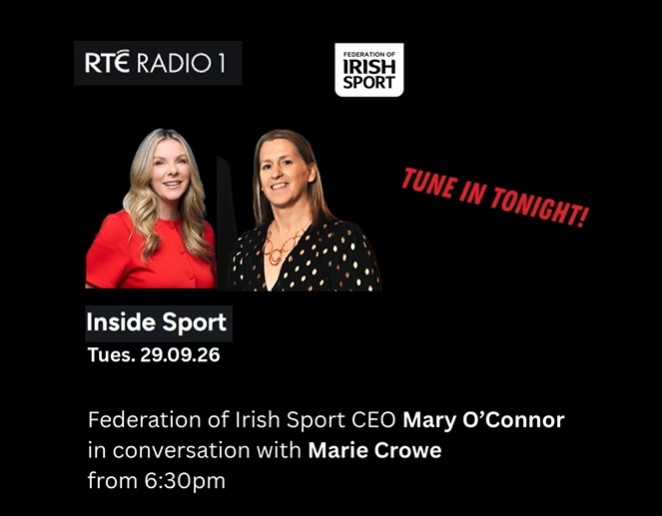
Mary O’Connor with Marie Crowe on RTÉs Inside Sport on Tuesday evening 29th September.
Click here to listen back.

Click here to read full Submission document.
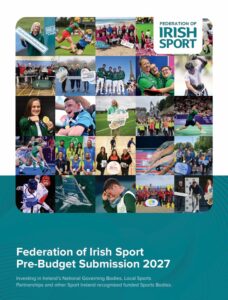
FIS Asks for Budget 2027:
- A 10% Annual Uplift in Funding for NGBs and LSPs.
- Introduction of a €5,000 Exemption PAYE Threshold for Certain Payments in Amateur Sport.
- Request for Government Commitment to Research and Publish a Report on an Additional 1% Betting Levy for Sport.
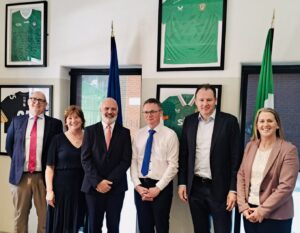
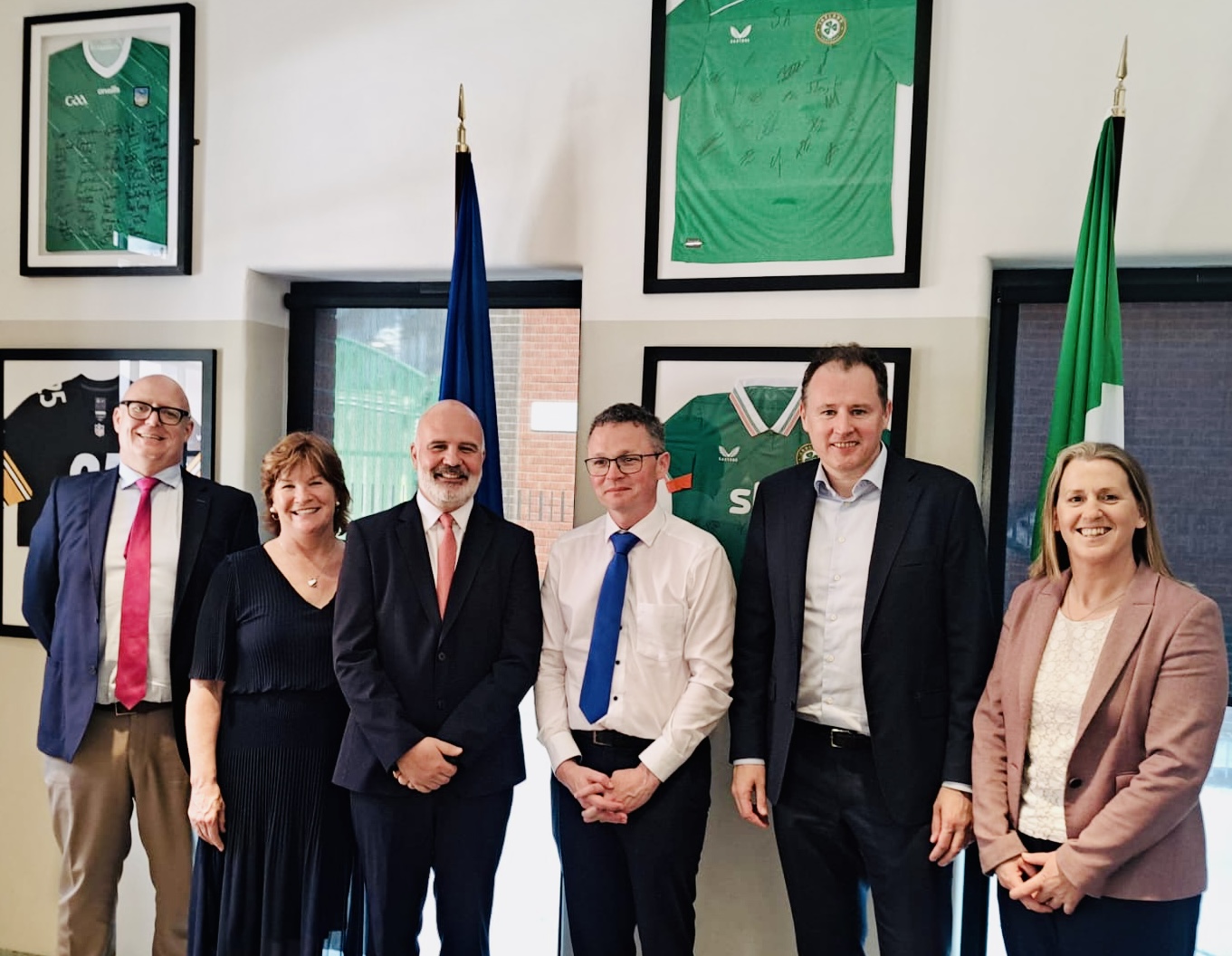
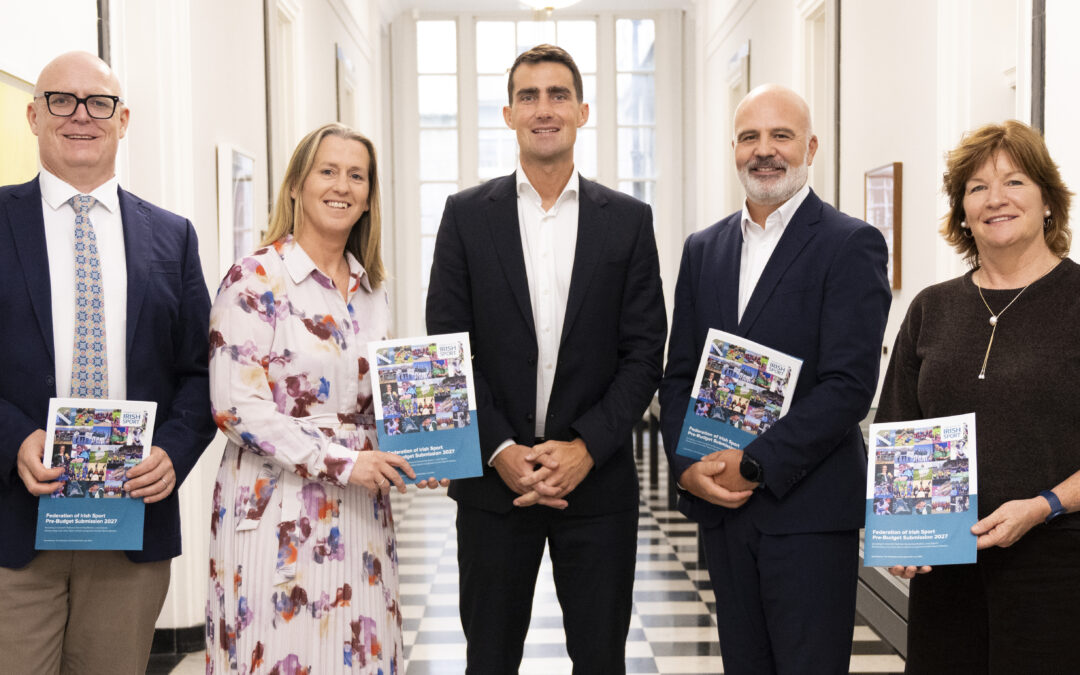
Pictured in May 2026: FIS Chair Enda Lynch CEO Badminton Ireland, Rosarie Kealy CEO Waterford Local Sports Partnership, John Perry Tax Partner at Ogier Ireland, Minister O’Donovan Minister of Culture, Communications and Sport, Minister McConalogue Minister of State for Sport and Postal Policy, FIS CEO Mary O’Connor.
The Federation’s pre-budget submission seeks a three-year commitment to increased funding for National Governing Bodies (NGBs) and Local Sports Partnerships (LSPs), measures to ease the burden on volunteers and local organisations, and a review of new funding options to support the future growth of sport in Ireland.
Recent Sport Ireland data shows that 2.12 million adults now regularly participate in sport, while nearly two in five adults are classified as highly active. This underlines the potential for increased investment in sport to deliver substantial benefits for public health, wellbeing, and the State.
Grassroots sport at risk
The Karshan Case ruling has had a significant impact on the sports sector impacting modest payments made by amateur and grassroots sports bodies to the coaches, referees, tutors, and officials whereby they must be declared and accounted for as PAYE employees. The application of standard employment status compliance requirements to these low-value engagements has created a level of administrative and financial burden that is disproportionate to the scale of the delivery and engagement involved and inconsistent with the underlying nature of sport and community participation delivery. The delivery of NGB and LSP sports programmes relies heavily on casual and seasonal engagement of tutors, coaches and officials. The impact is already being felt by Local Sports Partnerships with approximately 85% of them have already reduced programmes, training initiatives, or events during 2026.
The Federation of Irish Sport is proposing a €5,000 de minimis PAYE threshold for modest payments made by amateur and grassroots sports bodies to the qualified coaches, referees, tutors, and officials who keep community sport running. This proposal is a real and viable solution for Government to prevent the unintended consequences of the ruling.
Commitment to Research and Publish a Report on an Additional 1% Betting Levy for Sport
The Federation respectfully calls on the Minister and his Department to lead a Government commitment to research and report on the potential introduction of an additional 1% Betting Levy for Sport.
The proposed review would consider the fiscal, legal, and ethical feasibility of increasing the existing Betting Duty, with the additional revenue ringfenced for participation and community sport. An interdepartmental review, led by the Departments of Finance and Culture, Communications and Sport, and involving Sport Ireland and other stakeholders, should examine potential revenue, options for administering the funds—including a potential Sports Investment Fund—and the wider social and economic benefits of increased participation in sport. The review should also include any risks, constraints, and implementation considerations. Government has an opportunity to take a serious, evidence-based step towards creating a sustainable funding stream for sport. We are asking the Minister to lead that process and commit to publishing the evidence within 6–9 months.
Federation of Irish Sport CEO Mary O’Connor said: “A fundamental step-change in sports funding is required in Budget 2027. To build enduring programmes, retain vital personnel, and attract professional and volunteer talent, we must pivot away from short-term financial cycles. We urge the adoption of a multi-annual funding model built on an annual uplift of 10% over the next three consecutive years. This will empower the sector with the strategic certainty and financial security required to deliver long-term, meaningful outcomes for the state.”
Sport plays a transformative role in public life:
- 97,000 cases of disease were prevented through participation in sport and physical activity in 2019, saving the State €405 million in healthcare costs.
- Every €100 invested in sport returns up to €195 to the Exchequer through taxation.
- The sector contributes €3.7 billion to the Irish economy and supports 64,000 full-time equivalent jobs.
Sep 24, 2026
- New grant management system, SPRAOI, goes live on Monday 28 September
The Minister for Culture, Communications and Sport, Patrick O’Donovan TD and the Minister for State for Sport and Postal Policy, Charlie McConalogue TD today announced that a new grant management system for the Community Sport Facilities Fund (CSFF), SPRAOI, will go live on Monday 28 September.
Clubs and organisations not previously registered with the Department can register on SPRAOI from that date.
The CSFF is the Government’s primary vehicle for providing support to sports clubs and communities to develop sports infrastructure around the country.
Details of the new scheme will be announced by both Ministers next week. In the meantime, any clubs that are not already registered on the Department’s new SPRAOI system may do so from 28 September.
Clubs already registered on the previous OSCAR system have had their registrations automatically transferred to the new system but are encouraged to check their information for accuracy. Any first-time registrations are encouraged to check their status online by visiting www.gov.ie/sportscapital and, if they require any specific guidance, to email sportscapitalprogrammes@ccs.gov.ie
Sep 21, 2026
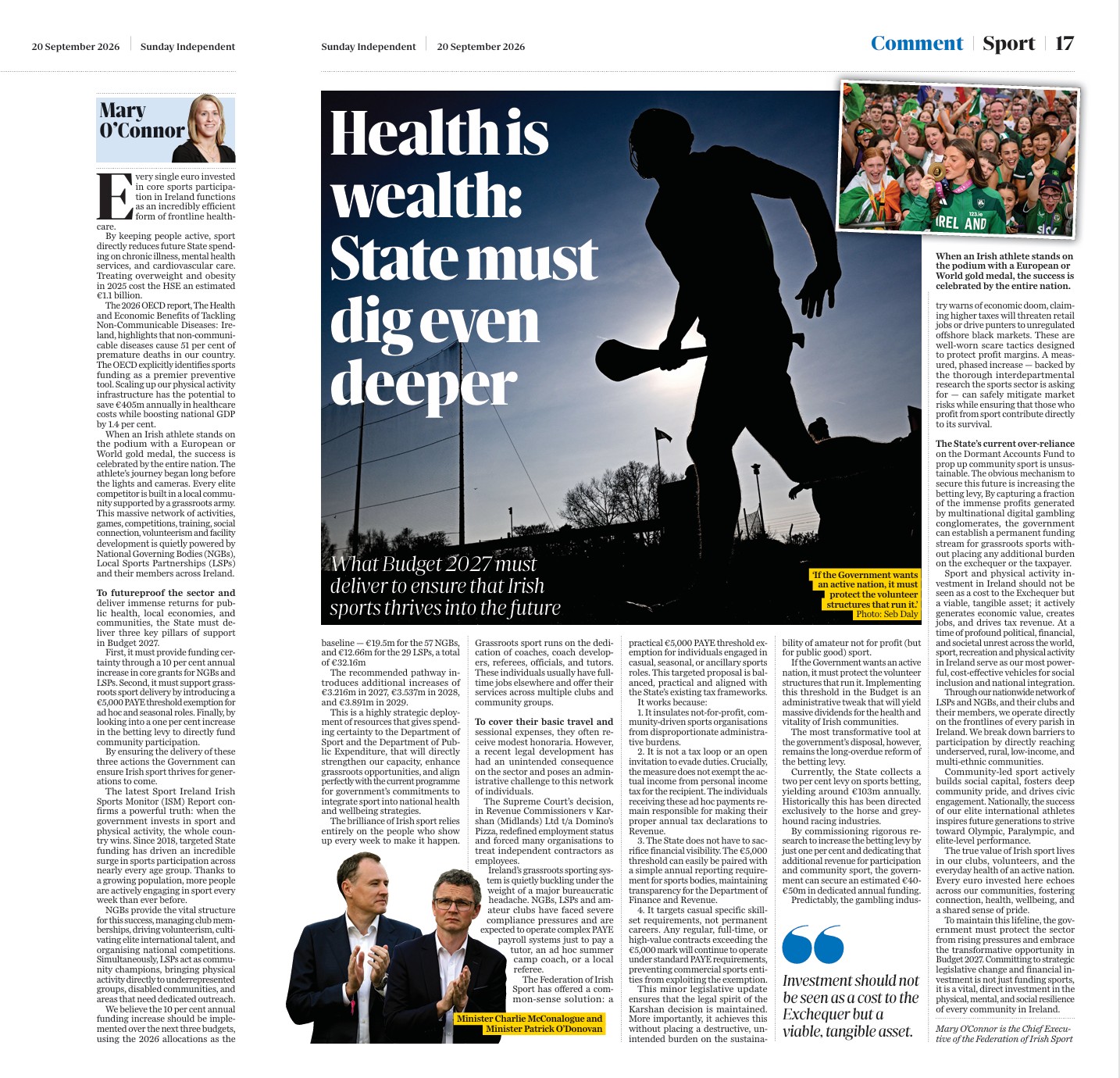
What Budget 2027 must deliver to ensure that Irish sport thrives into the future
By Mary O’Connor, Chief Executive Officer Federation of Irish Sport
Every single euro invested in core sports participation in Ireland functions as an incredibly efficient form of frontline health.
By keeping people active, sport directly reduces future State spending on chronic illness, mental health services, and cardiovascular care. Treating overweight and obesity in 2025 cost the HSE an estimated €1 billion.
The 2026 OECD report, The Health and Economic Benefits of Tackling Non-Communicable Diseases: Ireland, highlights that non-communicable diseases cause 51 per cent of premature deaths in our country. The OECD explicitly identifies sports funding as a premier preventive tool. Scaling up our physical activity infrastructure has the potential to save €405m annually in healthcare costs while boosting national GDP by 1.4 per cent.
When an Irish athlete stands on the podium with a European or World gold medal, the success is celebrated by the entire nation. The athlete’s journey began long before the lights and cameras. Every elite competitor is built in a local community supported by a grassroots army. This massive network of activities, games, competitions, training, social connection, volunteerism and facility development is quietly powered by National Governing Bodies (NGBs), Local Sports Partnerships (LSPs) and their members across Ireland.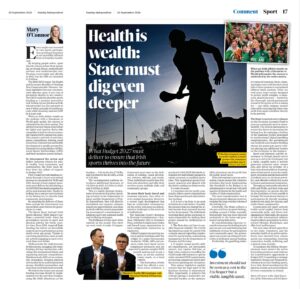
To futureproof the sector and deliver immense returns for public health, local economies, and communities, the State must deliver three key pillars of support in Budget 2027.
First, it must provide funding certainty through a 10 per cent annual increase in core grants for NGBs and LSPs. Second, it must support grassroots sport delivery by introducing a €5,000 PAYE threshold exemption for ad hoc and seasonal roles. Finally, by looking into a one per cent increase in the betting levy to directly fund community participation.
By ensuring the delivery of these three actions, the Government can ensure Irish sport thrives for generations to come.
The latest Sport Ireland Irish Sports Monitor (ISM) Report confirms a powerful truth: when the government invests in sport and physical activity, the whole country wins. Since 2018, targeted State funding has driven an incredible surge in sports participation across nearly every age group. Thanks to a growing population, more people are actively engaging in sport every week than ever before.
NGBs provide the vital structure for this success, managing club memberships, driving volunteerism, cultivating elite international talent, and organising national competitions. Simultaneously, LSPs act as community champions, bringing physical activity directly to underrepresented groups, disabled communities, and areas that need dedicated outreach.
We believe the 10 per cent annual funding increase should be implemented over the next three budgets, using the 2026 allocations as the baseline — €19.5m for the 57 NGBs, and €12.66m for the 29 LSPs, a total of €32.16m.
The recommended pathway introduces additional increases of €3.216m in 2027, €3.537m in 2028, and €3.891m in 2029.
This is a highly strategic deployment of resources that gives spending certainty to the Department of Sport and the Department of Public Expenditure, that will directly strengthen our capacity, enhance grassroots opportunities, and align perfectly with the current programme for government’s commitments to integrate sport into national health and wellbeing strategies.
The brilliance of Irish sport relies entirely on the people who show up every week to make it happen. Grassroots sport runs on the dedication of coaches, coach developers, referees, officials, and tutors. These individuals usually have full-time jobs elsewhere and offer their services across multiple clubs and community groups.
To cover their basic travel and sessional expenses, they often receive modest honoraria. However, a recent legal development has had an unintended consequence on the sector and poses an administrative challenge to this network of individuals.
The Supreme Court’s decision, in Revenue Commissioners v Karshan (Midlands) Ltd t/a Domino’s Pizza, redefined employment status and forced many organisations to treat independent contractors as employees.
Ireland’s grassroots sporting system is quietly buckling under the weight of a major bureaucratic headache. NGBs, LSPs and amateur clubs have faced severe compliance pressures and are expected to operate complex PAYE payroll systems just to pay a tutor, an ad hoc summer camp coach, or a local official.
The Federation of Irish Sport has offered a common-sense solution: a practical €5,000 PAYE threshold exemption for individuals engaged in casual, seasonal, or ancillary sports roles. This targeted proposal is balanced, practical and aligned with the State’s existing tax frameworks.
It works because:
- It insulates not-for-profit, community-driven sports organisations from disproportionate administrative burdens.
- It is not a tax loophole or an open invitation to evade duties. Crucially, the measure does not exempt the actual income from personal income tax for the recipient. The individuals receiving these ad hoc payments remain responsible for making their proper annual tax declarations to Revenue.
- The State does not have to sacrifice financial visibility. The €5,000 threshold can easily be paired with a simple annual reporting requirement for sports bodies, maintaining transparency for the Department of Finance and Revenue.
- It targets casual, specific skill-set requirements, not permanent careers. Any regular, full-time, or high-value contracts exceeding the €5,000 mark will continue to operate under standard PAYE requirements, preventing commercial sports entities from exploiting the exemption.
This minor legislative update ensures that the legal spirit of the Karshan decision is maintained. More importantly, it achieves this without placing a destructive, unintended burden on the sustainability of amateur not-for-profit (but for public good) sport.
If the Government wants an active nation, it must protect the volunteer structures that run it. Implementing this threshold in the Budget is an administrative tweak that will yield massive dividends for the health and vitality of Irish communities.
The most transformative tool at the government’s disposal, however, remains the long-overdue reform of the betting levy.
Currently, the State collects a two per cent levy on sports betting, yielding around €103m annually. Historically this has been directed exclusively to the horse and greyhound racing industries.
By commissioning rigorous research to increase the betting levy by just one percent and dedicating that additional revenue for participation and community sport, the government can secure an estimated €40–€50m in dedicated annual funding.
Predictably, the gambling industry warns of economic doom, claiming higher taxes will threaten retail jobs or drive punters to unregulated offshore black markets. These are well-worn scare tactics designed to protect profit margins. A measured, phased increase — backed by the thorough interdepartmental research the sports sector is asking for — can safely mitigate market risks while ensuring that those who profit from sport contribute directly to its survival.
The State’s current over-reliance on the Dormant Accounts Fund to prop up community sport is unsustainable. The obvious mechanism to secure this future is increasing the betting levy. By capturing a fraction of the immense profits generated by multinational digital gambling conglomerates, the government can establish a permanent funding stream for grassroots sports without placing any additional burden on the exchequer or the taxpayer.
Sport and physical activity investment in Ireland should not be seen as a cost to the Exchequer but a viable, tangible asset; it actively generates economic value, creates jobs, and drives tax revenue. At a time of profound political, financial, and societal unrest across the world, sport, recreation and physical activity in Ireland serve as our most powerful, cost-effective vehicles for social inclusion and national integration.
Through our nationwide network of LSPs and NGBs, and their clubs and their members, we operate directly on the frontlines of every parish in Ireland. We break down barriers to participation by directly reaching underserved, rural, low-income, and multi-ethnic communities.
Community-led sport actively builds social capital, fosters deep community pride, and drives civic engagement. Nationally, the success of our elite international athletes inspires future generations to strive toward Olympic, Paralympic, and elite-level performance.
The true value of Irish sport lives in our clubs, volunteers, and the everyday health of an active nation. Every euro invested here echoes across our communities, fostering connection, health, wellbeing, and a shared sense of pride.
To maintain this lifeline, the government must protect the sector from rising pressures and embrace the transformative opportunity in Budget 2027. Committing to strategic legislative change and financial investment is not just funding sports, it is vital, direct investment in the physical, mental, and social resilience of every community in Ireland.
Sep 15, 2026
With a number of important tax compliance deadlines falling between now and early 2027, it is worth taking the time to review upcoming obligations and ensure you are prepared well in advance. Below, we outline some of the key filing and payment deadlines and points to consider before submitting returns.
Capital Acquisitions Tax (CAT)
The valuation date is a critical factor for CAT purposes, as it determines when the CAT return must be filed and when any tax liability becomes payable.
The pay and file deadlines are as follows:
- Valuation dates between 1 January and 31 August: filing and payment are due by 31 October of the same year.
- Valuation dates between 1 September and 31 December: filing and payment are due by 31 October of the following year.
It is important to note that where the IT38 return is filed online and payment is made online, the deadline for gifts or inheritances with valuation dates in the year ending 31 August 2026 is extended to Wednesday, 18 November 2026.
Determining the Valuation Date
Establishing the correct valuation date is essential, as it determines the CAT compliance timeline.
For a gift, the valuation date is generally the date on which the gift is transferred.
For an inheritance, determining the valuation date can be more difficult. In most cases, it is the earliest of:
- The date on which the executor or administrator is entitled to retain the asset for the beneficiary;
- The date on which the asset is actually retained; or
- The date on which the executor or administrator transfers the asset to the beneficiary.
CAT Return Requirements
The requirement to file a CAT return should be considered when a gift or inheritance is received.
A return may be required even where no tax liability arises. For example:
- Where the beneficiary has used more than 80% of the relevant tax-free threshold; or
- Where reliefs such as Agricultural Relief or Business Relief are being claimed.
Capital Gains Tax (CGT)
The payment deadlines for CGT liabilities arising in 2026 are:
- Disposals made between 1 January 2026 and 30 November 2026: CGT is payable by 15 December 2026.
- Disposals made between 1 December 2026 and 31 December 2026: CGT is payable by 31 January 2027.
For companies, tax on chargeable gains generally falls due under the normal corporation tax payment and filing rules. However, where a company disposes of development land and a CGT liability arises, the standard CGT payment deadlines above apply.
Reporting CGT Disposals
The method of reporting a CGT disposal depends on the taxpayer’s circumstances.
Individuals who are chargeable for income tax and file a Form 11 should report disposals on their annual income tax return.
In certain cases, particularly where an individual has only PAYE income or non-PAYE income of less than €5,000, a Form 12 (paper or online) may be used. Where neither option is appropriate, a Form CG1 can be filed to report the disposal.
Corporation Tax
Corporation tax filing deadlines depend on a company’s accounting period. For companies with a 31 December 2025 year-end, the CT1 return will be due by 23 September 2026.
In addition to annual filing obligations, companies should also ensure they remain compliant with their preliminary tax requirements.
Preliminary Tax Deadlines
For large companies with an accounting period running from 1 January 2026 to 31 December 2026:
- The first preliminary tax instalment was due on 23 June 2026.
- A second instalment will be due on 23 November 2026.
If the June deadline was missed, any outstanding preliminary tax should be paid as soon as possible to minimise potential interest charges.
For small companies with the same accounting period, preliminary tax is payable in a single instalment by 23 November 2026.
Don’t Forget the Other Compliance Obligations
While the deadlines above represent some of the most significant tax obligations over the coming months, businesses and individuals should also keep on top of ongoing obligations such as:
- VAT returns
- Payroll taxes
- Stamp duty filings
- Dividend Withholding Tax (DWT)
- Other periodic Revenue compliance requirements
Contact OSK Tax today for more information on key tax compliance deadlines.
Sep 8, 2026
A €5,000 PAYE Threshold: A Small Fix That Would Save Grassroots Sport

About the author: John Perry is Tax Partner at Ogier and lead tax adviser to the Federation of Irish Sport.
Ireland’s grassroots sporting system is quietly buckling under a tax problem that was never aimed at it. As Budget 2027 approaches, there is a simple, targeted and fiscally responsible fix on the table: a €5,000 de minimis PAYE threshold for modest payments made by amateur and grassroots sports bodies to the coaches, referees, tutors and officials who keep community sport running. This is the “ask” the Federation of Irish Sport have been putting directly to Government, and it deserves to be granted.
What Karshan changed
The catalyst is the Supreme Court’s 2023 decision in Revenue Commissioners v Karshan (Midlands) Ltd t/a Domino’s Pizza. The case clarified the test for distinguishing a “contract of service” (employment) from a “contract for services” (self-employment), establishing a structured five-point framework that looks to the reality of the working relationship rather than the written contract. It was decided in a commercial gig-economy context, but its blanket application now risks capturing low-value, irregular and public-benefit engagements. Revenue, having persisted and won, is understandably focused on PAYE compliance across the board. To manage the fallout, Revenue opened a time-limited disclosure opportunity allowing employers to regularize payroll tax for 2024 and 2025 without interest or penalties where genuine misclassification had occurred, with the option available until 30 January 2026.
Why the exemption makes sense
Grassroots sport depends on people who coach, referee and tutor on a casual, seasonal basis, usually alongside a primary job, across multiple clubs, and for community rather than commercial motives. A €5,000 annual threshold would recognize the ancillary, non-commercial nature of that income while preserving full PAYE and reporting for higher-value or economically dependent roles. Crucially, it would not exempt anyone’s income from tax; the recipient remains liable, and the measure protects Exchequer revenue. It is also entirely consistent with existing policy: our tax code already uses de minimis thresholds and easements, from the Section 235 exemptions for sports bodies to PAYE exclusion orders. This is proportionate tax administration, not special pleading.
The cost of doing nothing
The evidence of inaction is already stark. In a survey covering roughly 90 percent of Local Sports Partnerships, about 85 percent reported cutting programmes, training or events in 2026, with many operating at 26 to 50 percent below normal capacity. These reductions are not demand-driven; demand remains strong, but organisations are constrained by compliance costs and uncertainty. Historic misclassification disclosures have most commonly landed in the €10,000 to €50,000 range. Between half and three-quarters of bodies report growing difficulty engaging tutors and coaches, who are simply walking away. For Companies Limited by Guarantee with thin reserves and no local-authority payroll support, this is now a genuine solvency and director-exposure risk. Left unaddressed, the sector faces further service cuts, higher participant fees and falling participation, undermining the return on significant public investment.
The campaign, and what comes next
This proposal is the product of sustained advocacy led by CEO, Mary O’Connor: a detailed Budget 2027 submission to the Department of Finance, sector-wide survey evidence, a Sport Ireland listening session, and a ministerial briefing setting out the ask. That engagement continues following productive meetings with Minister O’Donovan, Minister McConalogue and Minister Chambers. This is a clear, practical and low-cost action that protects tax integrity while safeguarding participation, volunteer capacity and public health. Budget 2027 is the moment to act.